
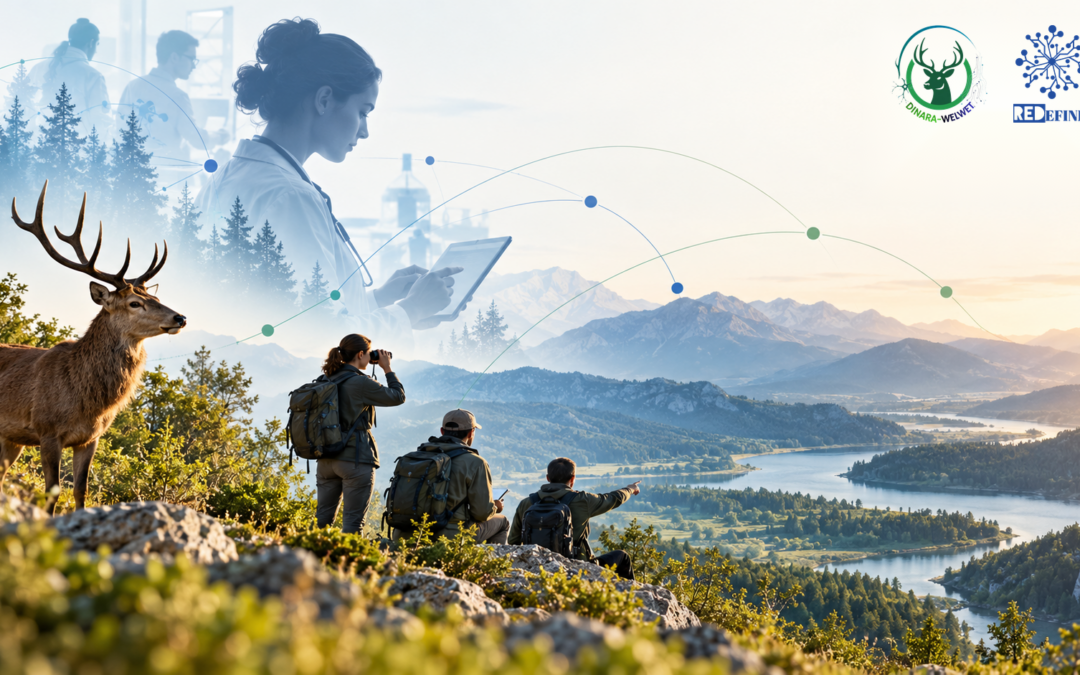
One Health is easy to explain: human health, animal health and environmental health are connected. The harder question is how people, institutions and learning systems actually work across those connections.
That question sits at the centre of REDefine’s work in DINARA-WELWET, where we are exploring how young people can build the practical skills needed for wildlife conservation, environmental resilience and One Health challenges.
Our new LinkedIn article, “One Health Is Easy to Agree With. Harder to Organise.”, looks beyond the familiar One Health diagram and asks what must exist around it if interdisciplinary action is expected to work in practice.
What is One Health?
One Health is an approach that recognises the close relationship between human health, animal health and environmental health.
A change in one part of that system can affect the others.
Wildlife disease can create risks for livestock and people. Water pollution can affect ecosystems, agriculture, local livelihoods and public health. Climate pressures can influence habitats, food systems, disease patterns and community resilience simultaneously.
The concept itself is straightforward.
The challenge is that many of the institutions responsible for responding to these problems are still organised separately.
Why is One Health difficult to put into practice?
Real-world problems rarely arrive neatly divided by profession or department.
A wildlife-health incident may require environmental evidence, veterinary expertise, biosecurity knowledge, public-health awareness, community communication and decisions made under uncertainty.
Each professional may understand one part of the problem very well.
The difficulty is connecting those parts quickly enough to produce an effective response.
That makes One Health not only a health or environmental issue, but also a question of governance, education, institutional coordination and professional practice.
What skills are needed for One Health?
Knowing that systems are interconnected is not the same as knowing how to work across them.
Young people preparing for environmental, conservation and green careers increasingly need to develop capabilities such as:
- gathering and interpreting evidence;
- understanding ecological and health risks;
- working across professional disciplines;
- communicating findings clearly;
- recognising the limits of their own expertise;
- knowing when a problem needs to be escalated;
- making decisions when information is incomplete;
- using digital tools appropriately;
- transferring knowledge from training into real environments.
This is why One Health education cannot stop at awareness.
It needs practice.
What does One Health education look like?
Effective One Health learning should give people opportunities to encounter the kinds of complexity they will face outside the classroom.
In DINARA-WELWET, our learning design combines different environments because different skills require different kinds of practice.
Field activities allow learners to observe real habitats, collect evidence and understand environmental conditions.
Digital learning environments can support preparation, protocols, background knowledge and reflection.
Virtual reality can create situations that would be difficult, expensive, unsafe or impossible to reproduce during conventional training.
The important point is that the technology is not the learning objective.
A VR environment is useful when it allows someone to practise a meaningful decision. GIS is useful when spatial information helps a learner understand what is happening in a real landscape. AI can be useful when it supports access to evidence or analysis.
The question should always come first:
What should the learner actually be able to do?
Technology follows from the answer.
Why does interdisciplinary learning matter?
One Health problems cross disciplinary boundaries, but interdisciplinary work does not mean that everyone needs to become an expert in everything.
In fact, one of the most important professional skills is knowing where your own expertise ends.
Good interdisciplinary practice depends on people being able to identify relevant evidence, communicate with specialists from other fields, understand responsibilities and handovers, and recognise when another kind of expertise is required.
Collaboration therefore needs more than goodwill.
It needs roles, protocols, evidence, communication and clear pathways for action.
How does One Health connect to youth skills and green careers?
Young people are increasingly being asked to respond to problems involving climate change, biodiversity loss, wildlife protection, environmental degradation, public health and resilient communities.
Many of the careers emerging around these challenges will not fit comfortably inside a single traditional discipline.
That creates an important educational question.
If future professionals are expected to work across systems, are our learning environments giving them opportunities to practise doing so?
Interest in sustainability is important. Environmental awareness is important.
But care is not yet capability.
Young people also need access to the tools, mentors, learning environments and professional pathways that allow concern to become competent action.
Why One Health is also a governance question
One Health is often presented as a scientific framework.
It is also an organisational challenge.
If environmental, health, agricultural and community systems need to respond together, institutions need mechanisms that allow information, evidence and responsibility to move between them.
Otherwise, we can have excellent expertise inside individual sectors while still struggling with problems that exist between them.
That is where the gap between agreement and action becomes important.
Almost everybody can agree that human, animal and environmental health are connected.
The more difficult task is building institutions, professional pathways and learning systems that allow people to behave as though they are.
From understanding One Health to acting on it
This is the question we explore in our latest REDefine article:
One Health Is Easy to Agree With. Harder to Organise.
Drawing on our work in DINARA-WELWET, the article looks at what happens after the One Health diagram: how skills are developed, where technology belongs, why interdisciplinary collaboration is difficult, and what institutions need if interconnected problems are to receive interconnected responses.
About DINARA-WELWET
DINARA-WELWET — Strengthening Youth Capacities in Wildlife Conservation Through One Health Initiatives and Virtual Reality Technology explores how practical learning, digital tools, field experience and interdisciplinary approaches can strengthen young people’s capabilities in wildlife conservation and One Health.
The project is co-funded by the European Union through Erasmus+ Capacity Building in the Field of Youth, Project No. 101247048.
Funded by the European Union. Views and opinions expressed are, however, those of the author(s) only and do not necessarily reflect those of the European Union or the granting authority. Neither the European Union nor the granting authority can be held responsible for them.
Frequently Asked Questions
What is One Health in simple terms?
One Health means recognising that the health of people, animals and the environment is interconnected. Problems affecting one part of the system can influence the others.
Why is One Health important?
Many current challenges — including zoonotic disease, biodiversity loss, environmental degradation, food-system risks and climate pressures — cross the traditional boundaries between human, animal and environmental health.
What skills are important for One Health careers?
Useful capabilities include evidence gathering, interdisciplinary collaboration, environmental observation, risk awareness, communication, problem-solving, digital literacy and decision-making under uncertainty.
How can technology support One Health education?
Technology such as GIS, virtual reality, digital learning platforms and AI can support One Health education when it helps learners practise a real capability, access relevant evidence or work with situations that cannot easily be reproduced through conventional training.
What is DINARA-WELWET?
DINARA-WELWET is an Erasmus+ Capacity Building in Youth project focused on strengthening young people’s capabilities in wildlife conservation through One Health approaches, practical learning and virtual reality technology.
