
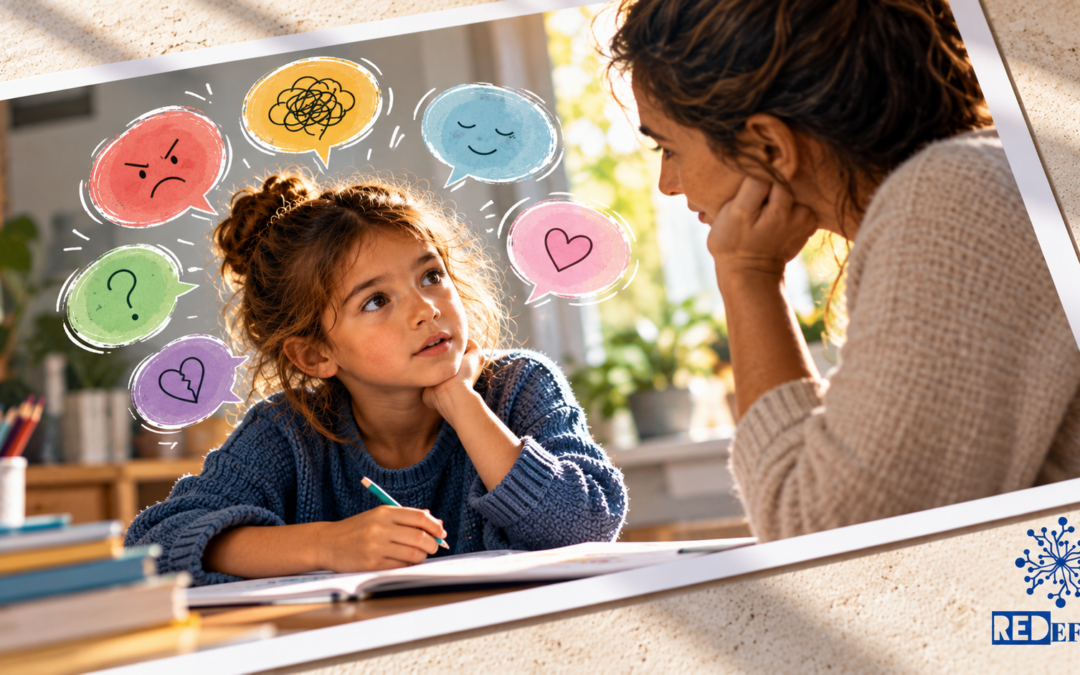
Helping children understand emotions is important. But what happens when they use those skills to question the adults around them?
Imagine telling an angry eight-year-old to stop shouting and use their words.
“I already did. I told you she keeps taking my things. You didn’t listen.”
That’s a rather uncomfortable response, particularly if the child has a point.
The shouting still needs addressing. So does the child’s frustration. But there’s also a third issue: perhaps the adults have repeatedly overlooked a boundary that matters to the child.
This is where emotional education becomes more complicated, and considerably more interesting, than teaching children to calm down.
What if successful emotional intelligence makes children better at disagreeing with us, rather than simply better at obeying?
Is emotional intelligence the same as obedience?
No. Emotional intelligence involves recognising and understanding emotions, communicating needs, managing behaviour, considering other people’s perspectives and navigating relationships. Obedience concerns following instructions.
The two can overlap, but they are not the same.
A child may follow every classroom rule without feeling confident enough to explain when something is wrong. Another may apologise immediately after an argument without understanding what caused the disagreement or how to repair the harm.
Conversely, a child who questions a rule may be demonstrating emotional awareness, communication skills and a developing sense of fairness, even if their frustration still needs guidance.
The distinction matters because our expectations often shape what we teach.
If we measure emotional progress primarily through fewer outbursts, less disagreement and better cooperation, we risk overlooking whether children are actually developing the confidence and judgment needed to navigate difficult situations.
Being calm is useful. Being capable is a much broader educational ambition.
When calming down doesn’t solve the problem
Consider two everyday situations.
At home, a child becomes angry because their younger sibling repeatedly takes their belongings without asking. The parent intervenes because the argument has become loud and unpleasant. Teaching the child to stop shouting is appropriate. But if the underlying boundary continues to be ignored, the child has learned remarkably little about how to resolve the actual problem.
At school, a pupil becomes upset because classmates keep laughing when they make mistakes. The teacher suggests a breathing exercise and encourages the child to return to the lesson.
Regulating the immediate distress may help. But the child’s emotional response is not the only issue requiring attention.
In both situations, adults need to distinguish between the behaviour that needs a boundary and the circumstances that may need to change.
Of course, not every disappointment means someone has behaved unfairly. Children also need to learn that some rules are necessary, that other people have legitimate needs and that frustration does not automatically entitle us to a different outcome.
But when a child communicates a genuine concern, emotional education should help them express it constructively, not simply become more comfortable tolerating it.
What does research say about teaching emotional intelligence to children?
A major 2023 meta-analysis published in Child Development examined 424 studies involving more than 575,000 students across 53 countries.
The researchers found that school-based social and emotional learning programmes were associated with improvements in emotional and social skills, behaviour, peer relationships, school functioning and academic achievement compared with control conditions.
The results also varied significantly according to programme content, context and implementation.
This is an important reminder that emotional learning is not a single technique with predictable results. Its value depends on what we teach, how we teach it and the environments in which children practise those skills.
And those environments extend well beyond a classroom activity or a parenting workbook.
Children notice what adults do when frustrated, whether apologies are mutual, how disagreements are resolved and whether expressing discomfort leads to being heard.
A child can learn the vocabulary of emotions in twenty minutes. Learning that their voice matters requires something more consistent.
How can parents and teachers encourage emotional intelligence without giving up boundaries?
The starting point is separating the emotion from the behaviour.
“You have every right to be angry. I won’t let you hit your sister.”
That response acknowledges the feeling while maintaining a necessary limit.
The next step is investigating the situation rather than assuming the emotional reaction is the entire problem. What happened beforehand? Is the child responding to an unmet need, a misunderstanding, a repeated conflict or a reasonable boundary they simply dislike?
Then adults can help children practise alternatives. Asking for help, explaining discomfort, taking a break, negotiating a disagreement and repairing harm are skills that require repeated opportunities to learn.
A parent might revisit a sibling conflict once everyone is calmer and agree on clearer rules about personal belongings. A teacher might address unkind behaviour among classmates while helping the upset pupil regain confidence.
Neither approach requires adults to agree with everything a child says.
It requires us to treat emotional regulation and problem-solving as connected, but distinct, responsibilities.
From four years of interdisciplinary work to 50 practical activities
These questions have been central to our work at Association REDefine.
Over the past four years, two projects focused on children’s emotional development have brought us into collaboration with psychologists, mental-health and child-trauma professionals, early childhood development specialists, teachers and experts in pedagogy.
That experience helped shape our new book, The Emotional Intelligence Toolkit for Home & School: 50 Practical Activities to Help Children Name Feelings, Calm Big Emotions, Build Empathy and Strengthen Social Skills.
Designed for families, caregivers and educators working with children aged approximately five to twelve, the toolkit covers emotional awareness, expression, self-regulation, empathy, friendships, conflict, boundaries and resilience.
Its purpose is not to turn every disagreement into a lesson or expect parents and teachers to become endlessly patient emotional coaches.
It is to provide practical ways of helping children understand what they feel, recognise other people’s needs and develop more possibilities for what they can do next.
Sometimes that means learning to manage anger. Sometimes it means acknowledging a mistake and making things right.
And sometimes it means finding the confidence to say, respectfully, that something doesn’t seem fair.
What happens when children become better at disagreeing with us?
That is the question at the centre of our latest Substack essay, Fifty Activities, and Considerably More Than Fifty Feelings.
The full article goes further into the research on emotional learning in families and schools, the difference between emotional regulation and compliance, children’s right to participate in decisions affecting them, and the educational philosophy behind our new toolkit.
It also explores a possibility that parents and teachers may find both encouraging and occasionally inconvenient: children who are learning emotional intelligence may become more capable of questioning our decisions.
Perhaps that deserves to be recognised as progress.
By Liliya Yakova and Association REDefine.
