

Inside Empowered by Empathy — and why the future of digital education is not simply more digital, but more human
The Five Seconds Before the Response
In almost every difficult interaction with a child, there is a small interval that rarely appears in training manuals because it is too brief to look important. A child is overwhelmed. Their voice rises. They push something away, refuse, withdraw, lash out or simply stop responding. The adult feels their own body react: a tightening in the shoulders, the little surge of irritation, the instinct to restore order quickly. Within perhaps five seconds, an entire philosophy of care can become visible.
One response begins with, “Stop that right now.” Another begins with, “I can see this is really difficult.” Neither sentence exists in isolation. Behind the first may be exhaustion, responsibility, time pressure and the perfectly reasonable need to maintain a boundary. Behind the second is not saintly patience but a learned ability to notice what is happening in two nervous systems at once. The interesting question is therefore not whether caregivers should be “nice”. It is whether the adults responsible for children have enough practical support to recognise emotion, regulate their own responses, interpret behaviour without rushing to judgement, maintain boundaries without escalating conflict and remain relationally present when the situation becomes difficult.
That question became the heart of Empowered by Empathy — Emotional Intelligence in Caring for Disadvantaged Children, an EU -Funded initiative, developed across Türkiye, Poland and Portugal. The project was explicitly built around emotional intelligence, early childhood education and care, new learning and teaching approaches, digital pedagogical practices and inclusion. Its central ambition was to strengthen the capacity of adults caring for disadvantaged children, particularly children in institutional care, to support healthy emotional development through empathy- and emotional-intelligence-based approaches.
There is serious developmental science behind that intuition. The Center on the Developing Child at Harvard describes responsive relationships with caring adults as important both for healthy development and for buffering children against harmful stress responses. Its work on resilience similarly identifies at least one stable and committed relationship with a supportive adult as a common protective factor among children who adapt well despite serious hardship.
That shifts the way we think about empathy. It is not decoration applied to care after the “real” work has been done. In many situations, the relationship is part of the mechanism through which the real work happens.
Empathy is not simply a feeling. In care, it becomes a professional competence
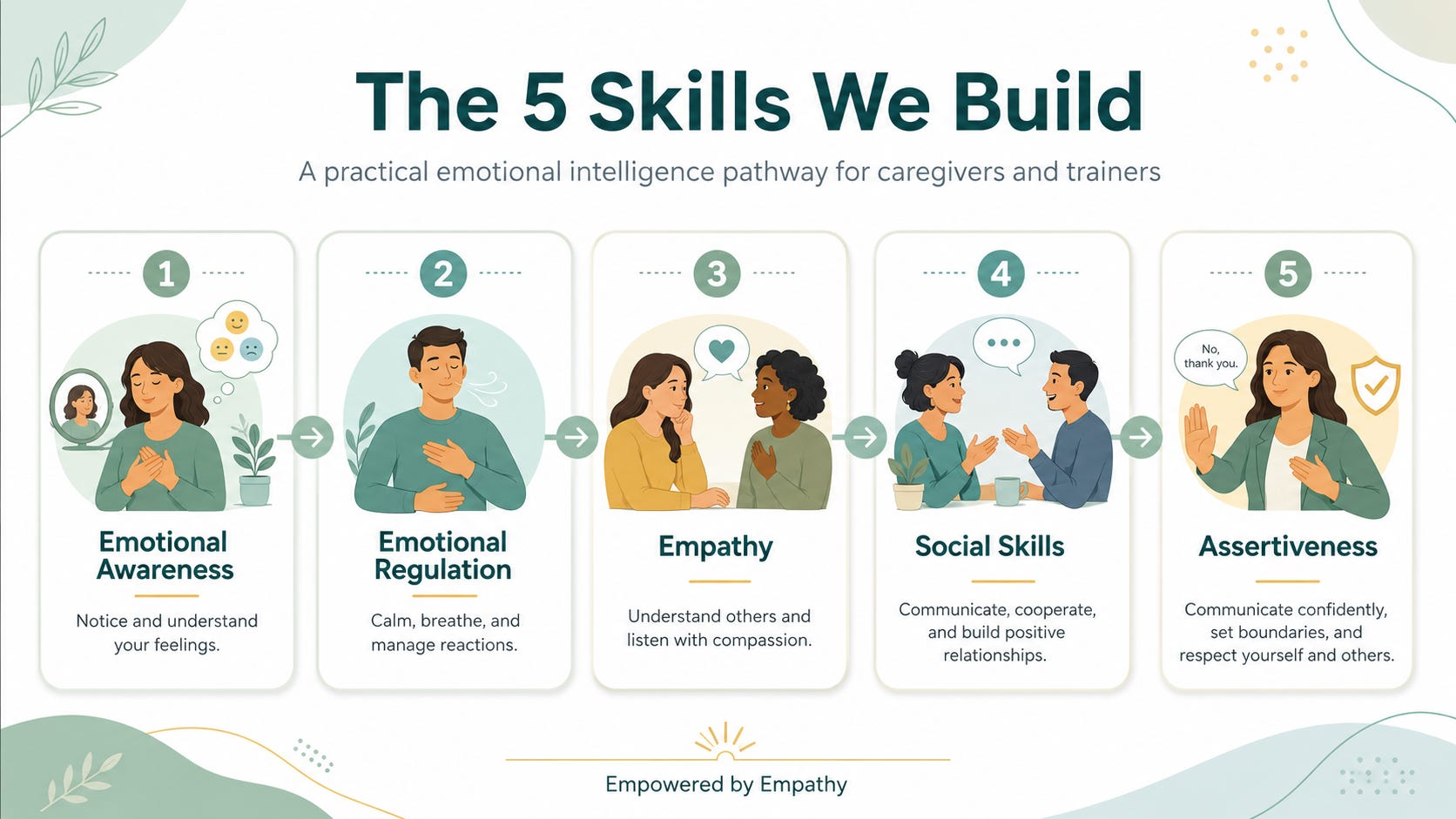
Emotional awareness. Emotional regulation. Empathy. Social skills. Assertiveness. These areas became a practical spine for the learning environment we helped build, because emotional intelligence becomes useful only when it leaves the vocabulary of aspiration and enters ordinary behaviour.
This is also why the project interested us so much at REDefine. It sits in a territory we increasingly consider essential: the place where a human problem, a body of knowledge, an educational programme and a digital system have to become one coherent experience.
Care Has an Emotional Operating System
We tend to organise care around what can be administratively seen. There are procedures, safeguarding protocols, shifts, assessments, responsibilities, reporting structures and professional standards. All of these are critical. Yet care also contains another layer that is much harder to capture in a spreadsheet: thousands of micro-interactions through which a child learns whether distress will be met with alarm, anger, dismissal, curiosity, steadiness or connection.
You might call this the emotional operating system of care. The metaphor is imperfect, as all technological metaphors for human beings eventually are, but it reveals something useful. The visible programme may be excellent, yet what a child actually experiences is mediated through repeated interaction: the face across the room, the tone of voice, the adult’s ability to remain regulated, the boundary that is clear without becoming humiliating, the question that is asked before an assumption is made.
Harvard’s work on responsive relationships offers an illuminating connection here. Supportive adults do not simply provide affection; their responses can help children regulate stress and build capacities that support later learning, behaviour and resilience. Responsive relationships are therefore not merely a pleasant addition to services. They are part of the developmental environment those services create.
The scale of the wider issue makes this more than an interpersonal question. UNICEF estimated in 2017 that at least 2.7 million children worldwide were living in residential care, while cautioning that incomplete data meant the real number could be substantially higher. UNICEF also warned that children in residential institutions can face increased risks of violence, abuse and long-term cognitive, social and emotional harm.
Empowered by Empathy does not pretend that caregiver training can resolve the structural problems surrounding institutional and alternative care. That would be both simplistic and irresponsible. What a programme like this can address is one particular layer of the system: the quality of the human interactions occurring inside it.
In our understanding, emotional intelligence should not be treated as a personality bonus possessed by unusually empathetic people. There is evidence that it can, to a meaningful extent, be strengthened through training. One meta-analysis examined 24 studies containing 28 adult samples and found a significant moderate improvement following emotional-intelligence training, with effects remaining at follow-up. A later meta-analysis covering 58 published and unpublished studies likewise found a moderate positive training effect.
That does not mean a workshop magically transforms a care system. It means something far more practical: these capacities are not fixed traits that organisations must simply hope their staff happen to possess.
We can create opportunities to practise them.
Before Teaching, Listen
One of the simplest principles in educational design is also one of the easiest to ignore: do not begin with what you want to teach. Begin with what the learner is encountering.
The original Empowered by Empathy architecture therefore placed a needs analysis before the educational programme. The project design was explicit about wanting to identify caregivers’ needs, risks, demands and differences between national contexts, then use that information to shape the training itself rather than simply producing a generic emotional-intelligence curriculum.
The eventual research engaged 100 caregivers, and its purpose was not to demonstrate that caregivers lacked commitment. Quite the opposite. The more interesting question was where professional experience, goodwill and responsibility still required more deliberate support. The findings pointed repeatedly toward areas such as emotional awareness, stress and emotional regulation, empathy, communication, crisis situations, social skills and assertiveness.
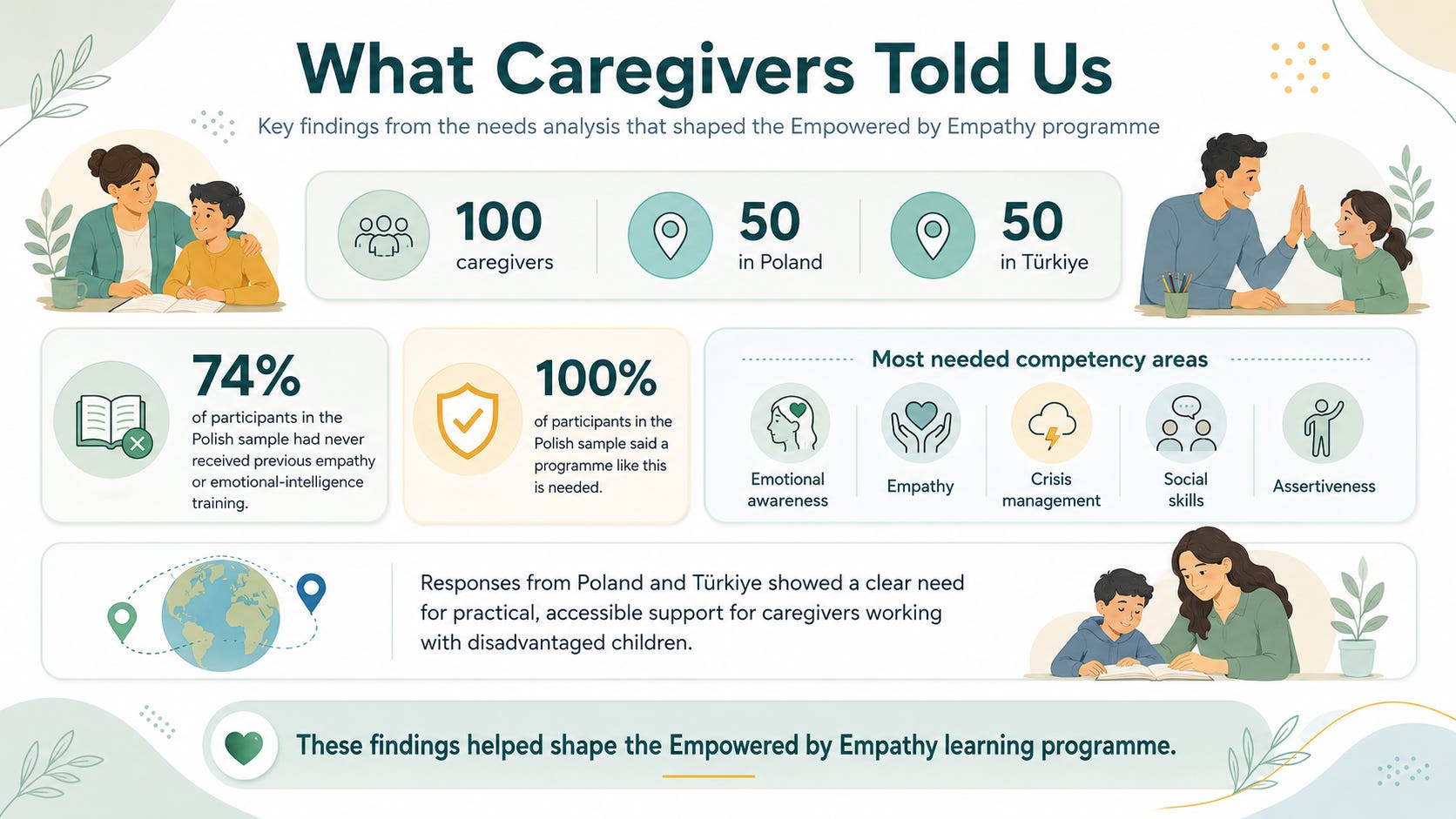
There is a larger design lesson hidden inside this. Needs analysis is sometimes treated as the ceremonial opening act of an educational project: collect some data, make a chart, and proceed to the curriculum everybody intended to write anyway. Its more valuable function is to expose the distance between being responsible for a difficult task and being explicitly prepared for all the capabilities the task actually requires.
Modern institutions are remarkably good at assigning responsibility. We are less consistent at identifying the invisible capacities hidden inside a responsibility. A caregiver may be formally responsible for safety, routines, development and behaviour while receiving much less support in the moment-to-moment competencies through which those responsibilities are enacted: remaining calm under provocation, recognising when anger may be covering fear, hearing distress without experiencing it purely as disobedience, or maintaining a boundary without rejecting the person.
In other words, the needs analysis was asking something more interesting than “What course should we make?”
What does this role require that the job description does not fully show?
That is a much better place to begin.
Then Came the Harder Question: How Do You Turn Empathy Into Something Teachable?
Once the learning needs become clearer, another difficulty appears. Empathy is remarkably easy to endorse and surprisingly difficult to operationalise.
You can write that caregivers should “listen actively”, “regulate emotions”, “maintain healthy boundaries” and “communicate assertively”. All of these statements are correct. They are also dangerously close to the sort of sentences that look excellent in a training manual while offering very little help at the precise moment somebody needs them.
Our responsibility at REDefine was the Digital Education Platform. In the original project design, this was not an incidental website task. REDefine was designated as the lead organisation for that output, with the platform expected to bring together the project’s learning resources, documents and videos, make them accessible to people unable to attend group training and support trainers, educators, academics and caregivers beyond the original activities.
That created a much more interesting design problem than putting a handbook online.
A PDF repository stores information. A learning platform designs a journey.
A repository asks: Where should the file go?
A learning environment asks: What does this person need next?
Those are not equivalent problems.
The distinction becomes particularly obvious when we imagine the two principal users. A caregiver might arrive after a difficult day, looking for one practical idea about managing an emotion or setting a boundary. A trainer may arrive while preparing a complete learning session and need structure, facilitation guidance, exercises, implementation support and evaluation materials.
Designing one pathway as though these were the same user would have made the platform technically complete and educationally clumsy.
So the platform developed two clear routes. The Guide for Caregivers focuses on practical emotional-intelligence skills, from recognising emotions and handling difficult moments to empathy, communication, social skills and assertiveness. Users can move sequentially or choose the topic that is useful to them now. The Training for Trainers pathway follows the programme session by session and adds guidance for facilitation, activities and practical application. Supporting activities, evaluation resources, project outputs and open educational materials sit around those central journeys.
The short walkthrough below shows how the platform works in practice: how users choose a pathway, move through the online handbooks, access downloadable materials and locate the support resources relevant to their role.
The technology itself is not the most interesting part. The architecture is.
A great deal of educational technology still behaves as though the learner’s job is to obey the system. We are much more interested in systems that earn the learner’s attention by being useful.
Explore the learning platform
If you would like to see the full environment rather than our description of it, the resources are open.
Designing Learning for the Moment It Is Needed
The platform became much more interesting when we stopped asking only, “What information belongs here?” and began asking another question: What would make this concept usable?
Consider emotional recognition. A handbook can define basic emotions perfectly well. Real life, inconveniently, does not normally present us with a labelled diagram. Behaviour arrives first. A child withdraws, fidgets, snaps, freezes, becomes unusually loud, refuses to participate or insists that everything is fine with a degree of intensity suggesting that everything is very much not fine.
That is why the learning environment combines explanations with visual anchors and scenario-based material.
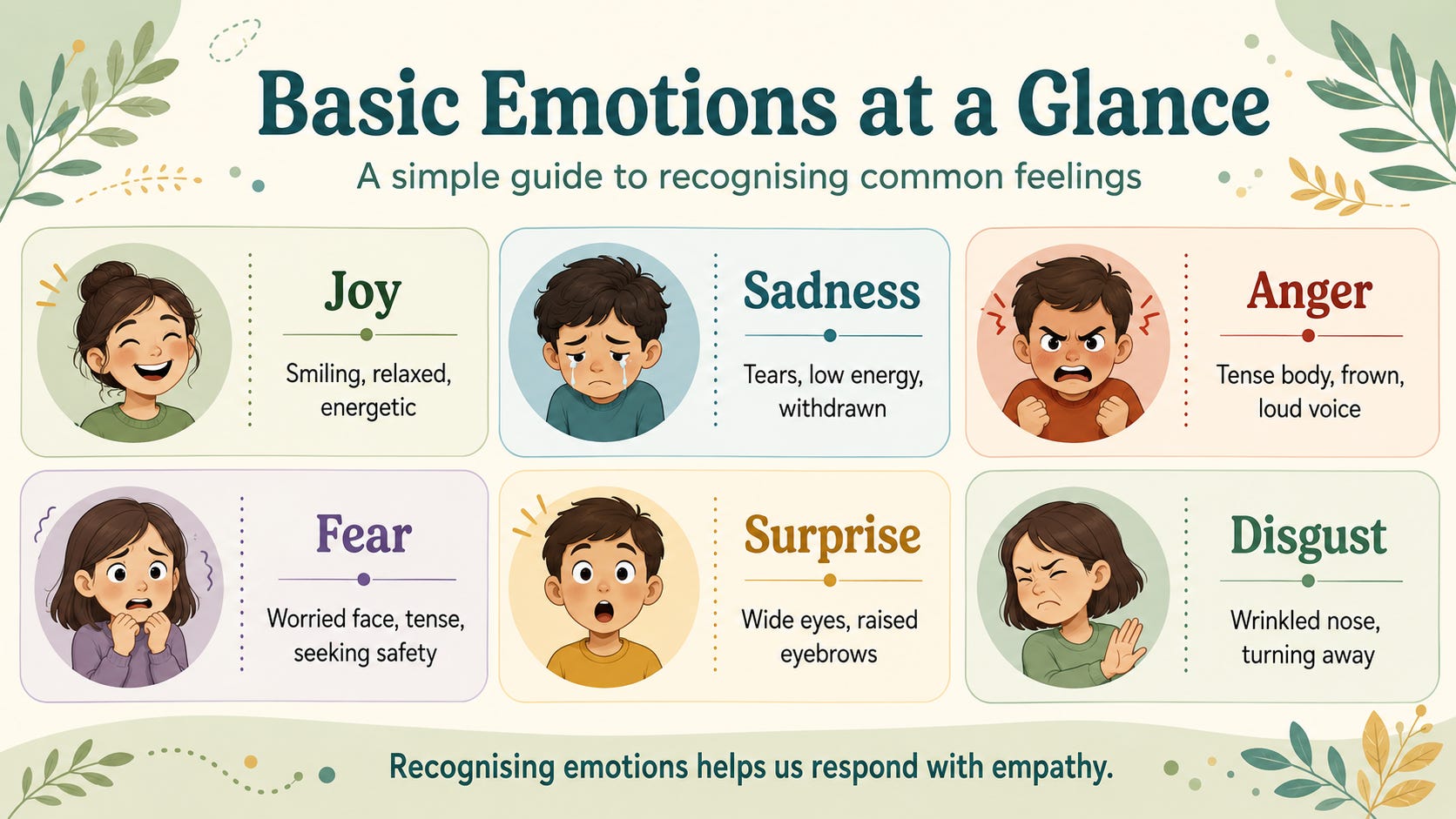
The purpose is not to suggest that emotion can be diagnosed from a facial expression. Quite the opposite. The learner is being invited to notice cues while preserving uncertainty. An emotionally intelligent response is not, “I know exactly how you feel.” It is closer to, “I notice something has changed. I wonder whether this word fits.”
That subtle movement from labelling to checking matters because it leaves the child some authorship over their own experience.
In Recognising and Naming Emotions in Real Life, we demonstrate this through everyday situations. An adult might say, “You seem quieter than usual today. I wonder if you’re feeling sad or disappointed about something.” If the child answers, “No, I’m worried,” the adult has not failed. The correction is part of the skill.
There is a deeper connection here that extends well beyond child care. Emotional literacy and democratic communication share a surprisingly similar principle: interpretation should remain open to reply. Whether we are talking about a child, a colleague, a community or a citizen, there is something fundamentally different between telling another person what their experience is and offering an interpretation they can confirm, reject or complicate.
That is the kind of connection we value at REDefine because it reminds us that competencies do not live in tidy institutional boxes. Listening, agency, interpretation and respectful disagreement recur across family life, education, organisational culture and democracy itself.
The crisis-management material develops this further.
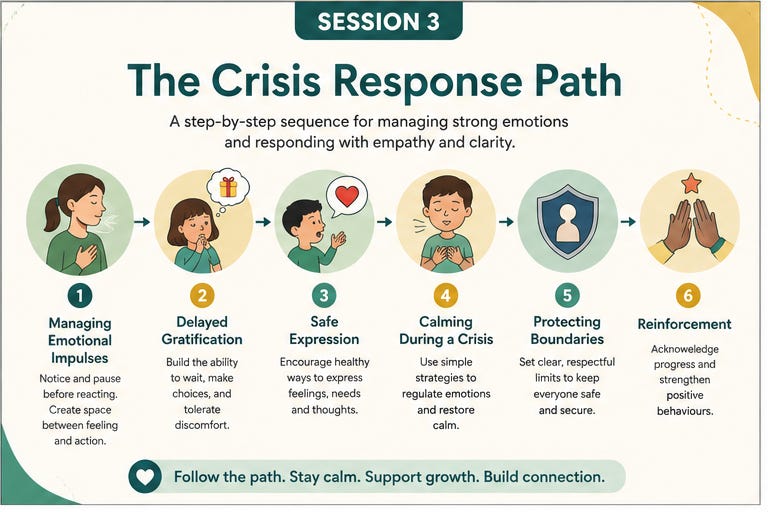
The session moves through managing emotional impulses, delayed gratification, safe expression, calming during a crisis, protecting boundaries and reinforcement. But underneath the sequence is an idea that sounds simple until a difficult situation makes it necessary:
the adult is part of the emotional system too.
Telling somebody to “remain calm” is technically correct and educationally close to useless. Calm has a body. It has timing. It has behaviour. It can look like noticing your shoulders tightening before you move closer, taking one breath before answering, deliberately reducing the volume of your voice, using fewer words instead of more, and protecting safety without converting the situation into a contest.
That is why Calming Down During a Crisis: What the Adult Does First shows the same crisis twice.
The child does not change. The trigger does not change. The boundary does not change.
Only the adult response changes.
In the first version, the adult becomes louder as the child becomes louder. Instructions multiply at precisely the moment the child has less capacity to process them. The adult moves closer, the child becomes more activated, and the interaction gradually transforms from a difficult emotion into a struggle over behaviour.
In the second version, the adult pauses, regulates their own body, lowers their voice, reduces the number of words, maintains the safety boundary and waits. The difficult emotion does not magically disappear. What disappears is some of the additional intensity the adult was contributing to it.
The most important person to regulate first is not always the child.
This led us to one of the most useful principles in the programme: regulation before reflection. We frequently try to reason our way out of physiological states that have temporarily weakened the very capacities reasoning requires. The order matters.
This is not permissiveness. The programme repeatedly separates emotion from behaviour. A child can be angry and throwing something can still be stopped. Empathy does not dissolve boundaries. One of the more useful insights of the programme is precisely that warmth and structure are not opposites.
The empathy section gives us another example.
There is a peculiar form of impatience hidden inside helpfulness. Somebody presents a difficulty and almost immediately our minds begin producing recommendations.
Parents do it. Teachers do it. Organisations do it. Policymakers do it. Consultants have, historically, shown a particular gift for it.
We move from problem to intervention with impressive efficiency, sometimes before the person describing the problem has reached the full stop.
The exercise I Am Just Listening: Empathy Without Fixing deliberately slows that instinct down. It uses the same conversation twice. A child describes being excluded by friends at school.
In the first version, the adult reassures, interrupts and begins producing solutions. “They aren’t real friends.” “Sit somewhere else.” “Tell the teacher.”
Much of the advice may be entirely sensible.
That is exactly why the example works.
The problem is not that the caregiver does not care. The problem is that the adult moves to the solution so quickly that the child’s experience becomes a loading screen before the advice.
In the second version, the adult waits. They reflect what they heard. They allow silence. The child continues. Only after the child feels understood does problem-solving appear, and even then it enters as an invitation: “Would you like me to listen a little longer, or would it help to think together about what you could do?”
Help is not defined solely by the quality of the solution. Timing is part of help.
There is an unusually broad lesson here. Institutions, consultants, teachers, policymakers and parents all make a similar mistake when we answer a question before we have adequately understood the experience that produced it.
Finally, the assertiveness section challenges another assumption: that empathy requires yielding.
The programme distinguishes passive, aggressive and assertive communication because caregivers need language that protects dignity on both sides of an interaction. “You are not allowed to be angry” attempts to control another person’s emotional state. “I want to listen, but I will not continue the conversation while we are shouting at each other” does something different: it recognises the emotion while establishing a boundary around the interaction.
A healthy boundary does not say that the other person does not matter.
It says:
You matter — and I matter too.
The platform takes that idea further in Boundaries, Saying No and I-Language, with practical phrases for expressing needs, setting limits, refusing respectfully and combining boundaries with I-language.
There are entire organisations that could use that lesson.
What REDefine Actually Builds
Empowered by Empathy is a project about emotional intelligence. It is also a useful case study of the type of work REDefine increasingly wants to be known for.
Our contribution sits at an intersection that is often fragmented between work packages, contractors or departments: research, pedagogy, digital architecture, visual communication, multilingual accessibility and public-facing storytelling. We are less interested in treating these as separate products than in making each one strengthen the others.
The project design assigned REDefine responsibility for the Digital Education Platform, building on our previous experience in e-platform development, systems design and online training. The platform was intended to integrate the other project outputs, widen access beyond people able to attend physical training and remain useful as an open educational resource.
But the more important lesson after doing the work is that digital transformation is rarely a technology problem alone.
A platform can fail with excellent code. A curriculum can fail with excellent content. A beautifully designed resource can fail because nobody understands where it belongs. A multilingual project can fail because translations technically exist while the learner experience fractures into unrelated versions. A dissemination strategy can satisfy every contractual obligation and still produce outputs that nobody feels invited to use.
This is the space REDefine works in: converting dispersed expertise into an intelligible system.
One way of seeing that is through the trainer pathway.
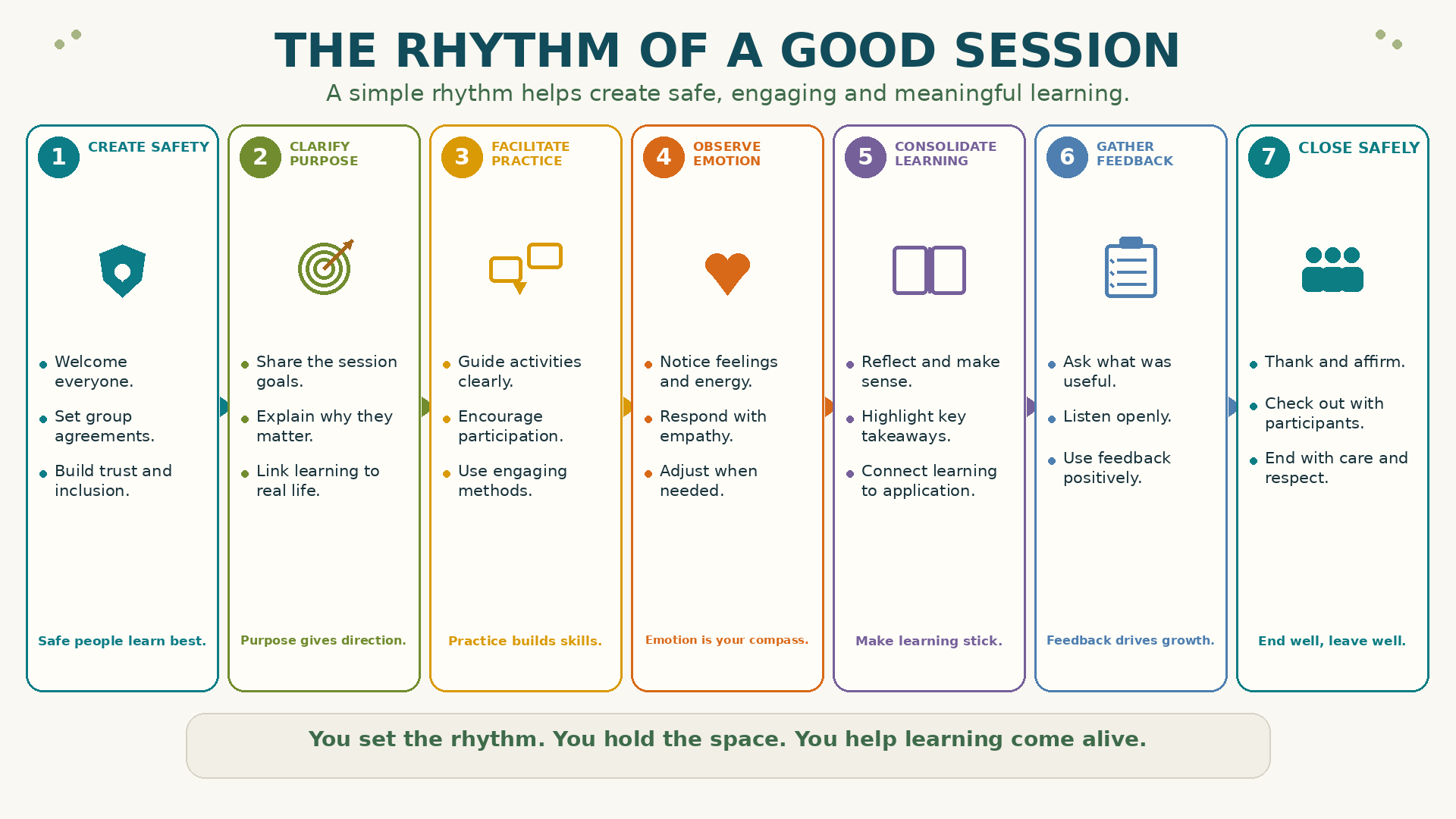
The model follows a deliberately simple sequence: create safety, clarify purpose, facilitate practice, observe emotion, consolidate learning, gather feedback and close safely.
Its purpose is not to replace professional judgement with seven attractive boxes. It is to make the hidden architecture of facilitation visible.
A trainer is not simply transmitting content. They are creating a temporary social environment in which other people are expected to think, expose uncertainty, practise unfamiliar behaviours, receive feedback and occasionally discover that something they have done for twenty years can be done differently.
That is a demanding environment to hold.
There are moments for instruction, moments for practice, moments for observing the emotional temperature of the room and moments for closing carefully rather than informing everyone that they have three minutes to complete the evaluation before the coffee disappears.
Good facilitation is partly intellectual and partly temporal.
The same design logic carries into the supporting materials. The One-Day Empathy Diary, Obstacles to Being a Good Listener, My Social Compass and Communication & Behaviour Styles resources were given coordinated visual identities so that trainers can recognise them as parts of one professional toolkit rather than four unrelated downloads.
This may sound like cosmetic work.
It is not.
Recognition reduces friction. Consistency reduces cognitive overhead. Visual hierarchy helps users predict where information belongs. In digital product design, we treat these as basic usability principles. Educational environments have an odd habit of occasionally forgetting them.
Why We Cared About the Small Things
Some of the most consequential design choices in a learning platform are almost invisible.
A caregiver should not have to read thirty pages before reaching the section that addresses the problem they are dealing with. A trainer should be able to recognise whether a resource is intended for preparation, delivery, reflection or evaluation without opening every PDF. A distinction such as passive versus assertive communication should sometimes become visually comparable instead of receiving another page of explanation. A video about emotional regulation should demonstrate emotional regulation rather than simply narrating a definition over generic footage of people smiling near windows.
This is why we spent time on visual pathways, session identities, translated infographics, trainer-resource covers, scenario-based videos and subtitle files across the project languages. None of these interventions is spectacular in isolation. Collectively, they change the character of the environment from an archive into a toolkit.
There is an interesting connection here to a much older field that digital education periodically rediscovers as though it had just been invented: ergonomics.
Good ergonomics does not ask the person to become more skilled at tolerating the tool. It asks whether the tool can be better fitted to the person.
Digital learning should work the same way.
We speak constantly about learner engagement, often as though engagement were a mysterious psychological substance educators must somehow extract from reluctant human beings. Sometimes disengagement is much less mysterious. The system is confusing. The information is badly sequenced. The person is tired. The resource looks disposable. The page requires six decisions before anything useful happens.
Good educational design cannot remove fatigue, stress or complexity from life.
It can avoid unnecessarily adding to them.
That is a less glamorous ambition than “revolutionising learning”.
It is also considerably more useful.
The Paradox: Teaching Human Connection Through a Screen
There is an obvious irony at the centre of Empowered by Empathy. We built a digital platform to teach competencies that are fundamentally relational.
A server cannot empathise. A database does not care whether you feel understood. Moodle has yet to demonstrate a secure attachment style.
This is probably reassuring.
The purpose of educational technology is not to become the relationship. It is to support the conditions in which better relationships can be practised.
That distinction becomes increasingly important as AI, automation and digital learning systems move more deeply into education, health, social services and everyday life. Technology companies increasingly describe systems in the vocabulary of human roles: tutors teach, assistants support, companions converse. The more human the interface appears, the more important another question becomes.
Which human capability are we strengthening, and which are we quietly outsourcing?
Empowered by Empathy sits deliberately on the strengthening side of that line.
The platform does not attempt to decide what a child is feeling for the caregiver. It gives caregivers a vocabulary and a method for exploring emotion more carefully.
It does not automatically solve a conflict. It helps adults examine their own contribution to escalation.
It does not replace the trainer. It helps the trainer prepare.
It does not prescribe one perfect pathway through the material. Users can start with the challenge that matters now, explore the relevant resource, practise and return later — precisely the navigation logic built into the platform.
That is what we mean by human-centred digital learning. It is not a pastel colour palette or rounded corners.
It is a series of decisions about where agency lives.
Technology should not replace the relationship. It should make better relationships easier to practise.
Built Across Borders, Designed for Use Beyond Them
Empowered by Empathy brought together Kırıkkale Social Services Association (KISODER) as coordinator, the Kırıkkale Provincial Directorate of Family and Social Services in Türkiye, Instytut Family Center in Poland and REDefine in Portugal. The consortium was deliberately complementary: frontline social-service experience, family education, emotional-intelligence expertise, adult learning and digital-platform design were brought into the same project architecture.
This is one of the things international cooperation can do exceptionally well when partnership design is taken seriously. European projects are sometimes described primarily through geography: three countries, four partners, several meetings. Geography matters, but expertise matters more.
The productive partnership is not one in which every organisation performs roughly the same work in a different language. It is one in which different forms of knowledge become dependent on one another.
The practitioner knows where theory breaks. The researcher knows where intuition needs evidence. The trainer knows what a group can realistically absorb. The digital designer knows where the learner will become lost. The communicator knows whether anyone outside the consortium will understand why the work matters.
A strong project is not simply the sum of those specialisms. It is the point at which they begin correcting one another. The needs analysis informs the programme. The programme informs the handbook. The handbook informs the platform. The act of creating the platform then forces another set of questions about navigation, sequencing, visualisation and use.
Knowledge does not merely travel from one partner to another. It changes shape.
The Grant Ends. The Resource Shouldn’t.
European programmes have a peculiar temporal problem. They fund periods: twelve months, sixteen months, twenty-four months, thirty-six months.
Human problems are inconsiderate enough not to organise themselves around those calendars.
Empowered by Empathy ran from 1 April 2025 to 31 July 2026. Its project design explicitly envisioned the training programme, materials and Digital Education Platform as publicly accessible resources capable of reaching caregivers beyond the original face-to-face activities.
That intention matters because one of the persistent weaknesses of project culture is the gap between completion and continuation.
A final report can prove that an output was produced. It cannot make anybody use it.
A dissemination conference can establish that stakeholders saw the platform. It cannot make the platform worth returning to.
Sustainability is therefore partly a funding question, but it is also a design question. If an output requires the original consortium, the original trainer, the original meeting and the original funding period in order to make sense, then its public life has been designed rather narrowly.
An open learning environment changes that equation. It can become, simultaneously, the project’s classroom, library, memory and front door.
Someone who never attended a transnational meeting can use it. Someone who discovers the project next year can use it. A trainer can borrow one activity. A caregiver can arrive through one difficult situation rather than through the abstract idea of “the project”.
This is the point at which a digital output stops being a dissemination accessory and becomes part of a project’s legacy.
The grant can end. The learning should not.
Use Empowered by Empathy
If you are a caregiver, trainer, educator, social worker, family-support professional or organisation working with children, the learning environment is open.
You can explore emotional awareness and regulation, crisis management, empathy and listening, social skills, communication, assertiveness and boundaries. Trainers can also use the session guidance, practical activities and evaluation resources.
→ Explore Empowered by Empathy
And If You’re Building the Next One…
For REDefine, Empowered by Empathy also represents something larger than one platform.
We are increasingly interested in the difficult middle between producing knowledge and making knowledge usable.
A research consortium may know an extraordinary amount about a subject and still struggle to convert that expertise into something a learner can navigate. An organisation may have an excellent handbook and no meaningful digital architecture. A project may have five deliverables, four languages, multiple audiences and several dozen resources, only to discover at the dissemination stage that “put everything on the website” is not actually an information strategy.
This is where our work tends to begin.
We work on the architecture connecting the pieces: turning research into learning journeys, complex materials into understandable interfaces, dense concepts into visual explanations, activities into coherent digital pathways and multilingual outputs into one recognisable ecosystem.
We also care about something that belongs equally to strategy and design: what survives compression.
Every project contains more knowledge than a learner can absorb at once. Every platform therefore forces choices about hierarchy. Every infographic forces choices about emphasis. Every video forces choices about what must be seen rather than simply said.
Those choices are not neutral. They reveal what an organisation believes is important.
This is why learning design is, quietly, a form of strategy. You cannot structure knowledge without deciding what leads to what, what a learner needs first, what can wait, what deserves repetition and what should disappear from the interface entirely.
Empowered by Empathy gave us an unusually useful environment in which to practise that craft because its subject refuses simplification. Human emotion does not fit obediently into modules. Care does not happen in tidy scenarios. Empathy does not always mean agreement. Boundaries do not always feel kind. Listening does not always solve anything.
A useful learning environment therefore cannot promise neatness.
What it can offer is orientation.
That distinction may be the most REDefine conclusion we can draw from the project.
We are surrounded by technologies promising to remove friction, systems promising to automate judgement and platforms promising to personalise everything. Some of those developments are extremely valuable. But there are also domains in which friction is not simply a technical defect. Sometimes the difficult part is the human part: waiting, listening, disagreeing respectfully, regulating yourself before responding, discovering that your first interpretation was wrong.
The purpose of good technology in those moments is not to erase the human difficulty. It is to help us become better equipped to meet it. That is what we tried to build here.
If your organisation is developing a learning platform, multilingual educational resource, other knowledge environment, open educational toolkit, training programme or public-learning initiative — and you are asking how to turn the content into something people can actually understand, navigate and use — this is precisely the intersection where we like to work.
Explore Empowered by Empathy →
And if you want to follow our work on the spaces where education, technology, civic intelligence and human-centred design meet, subscribe to REDefine // Civic Intelligence.
Good project dissemination tells people what you produced. Good learning design gives them a reason to use it.
Sometimes the most important legacy a project can leave is not another document explaining what should change, but a tool that quietly helps somebody respond differently in the next five seconds.
Empowered by Empathy — Emotional Intelligence in Caring for Disadvantaged Children was co-funded by the European Union. The views and opinions expressed are, however, those of the authors only and do not necessarily reflect those of the European Union or the granting authority. Neither the European Union nor the granting authority can be held responsible for them.
