

Democracy does not only depend on elections. It depends on habits. And many of those habits are learned, practiced, or lost in school.
1. Peace education has a branding problem
Peace education has always suffered from sounding gentler than it is. The phrase seems to arrive wearing soft colors. It sounds like paper doves on a classroom wall, children holding hands in a poster, assemblies about kindness, and carefully chosen words spoken in rooms where the actual world is on fire. It sounds like something well-meaning adults reach for after something has already gone wrong: after the bullying case, after the racist incident, after the fight in the playground, after the conflict that could no longer be ignored. It sounds, to many people, like a polite educational accessory rather than a serious response to social breakdown.
That is exactly the mistake. Peace education is not soft because peace is not soft. Peace is hard. Peace is the discipline of living with people who do not think like you, worship like you, vote like you, look like you, remember history like you, speak like you, or experience society from the same position of safety or vulnerability. Peace is not silence. It is not politeness. It is not the absence of tension. Peace is the ability to keep a shared world from collapsing under tension. It is the capacity to enter conflict without immediately turning another human being into an enemy. It is the practice of protecting dignity when emotions are high, when identities feel threatened, when history is heavy, and when the easiest thing in the room is contempt.
We confuse peace with calm. That confusion has weakened the public imagination around education. A quiet classroom may be peaceful, but it may also be frightened, silenced, controlled, or exhausted. A school with few reported incidents may be genuinely healthy, but it may also be a place where students have learned that speaking honestly is unsafe. A society without open violence may still be full of humiliation, exclusion, resentment, distrust, and quiet forms of cruelty. Calm is a surface condition. Peace is a deeper structure.
Democratic societies do not need calm children who have learned to avoid discomfort at all costs. They need young people who can handle complexity, disagreement, difference, anger, uncertainty, and moral tension without turning those experiences into hatred. They need young people who can recognize when they are being manipulated by fear, when a group is being scapegoated, when loyalty is being confused with obedience, and when the person on the other side of an argument is being made easier to dismiss. They need young people who can repair harm without denying it, speak up without humiliating, and participate in collective life without needing everyone else to become a copy of themselves.
This is why peace education should not be treated as a sentimental extra. It is not the decorative edge of education. It is one of the foundations of democratic survival.
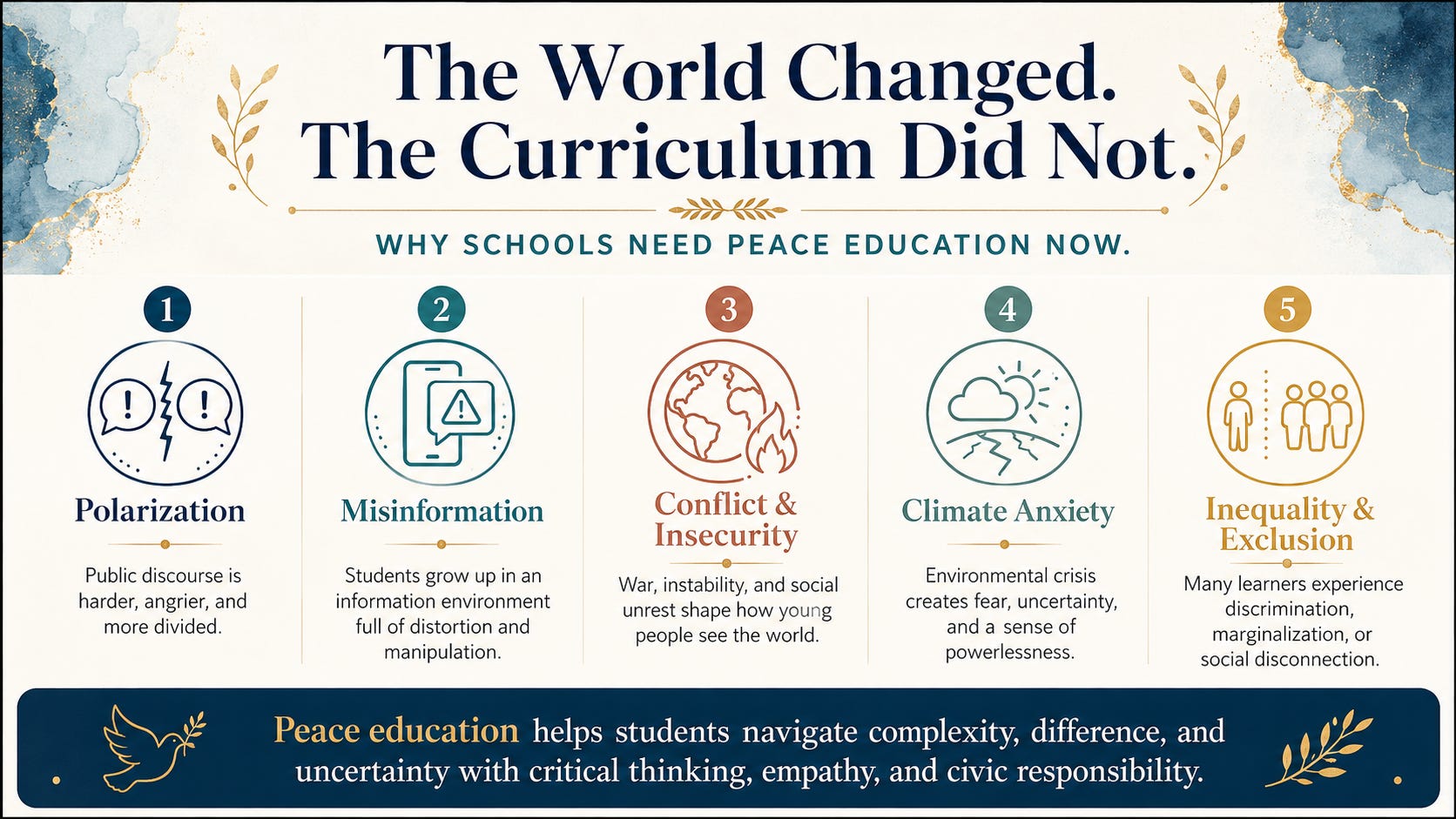
2. The world changed. The curriculum did not catch up.
Schools are no longer only places where students learn subjects. They are places where many of society’s unresolved conflicts arrive every morning, sometimes with a backpack, sometimes with a phone, sometimes with a silence. Migration arrives in the form of belonging and exclusion. Inequality arrives as exhaustion, shame, comparison, or hunger. Racism arrives as jokes that are not jokes. Political polarization arrives as slogans repeated before they are understood. Online hostility arrives as social tension that began the night before and continues under the desk during class. War anxiety, climate anxiety, family stress, economic insecurity, misinformation, gender hostility, and distrust of institutions do not wait politely outside the school gate.
The Mainstreaming Peace Education in Schools project began from this reality. It recognized that globalization and technology have transformed how people belong, connect, and interact, while also bringing challenges that can deepen inequalities and increase social conflict, community tension, and identity-based unrest. It identified schools as being on the frontline of these changes because classrooms increasingly bring together students from diverse social, cultural and ethnic backgrounds. This is not an abstract diagnosis. It is the daily life of many teachers. The classroom has become a meeting point for pressures that adults have not solved elsewhere.
The OECD’s Trends Shaping Education 2025 places education inside a wider world of rising inequality and polarization, rapid advances in artificial intelligence and virtual reality, global conflict and cooperation, changing relationships to work, new forms of storytelling, and growing concern for physical and mental wellbeing. This matters because education systems often move slowly, while the social forces shaping students move quickly. A curriculum may still be organized around the assumption that knowledge is delivered in stable institutions to students whose main task is to absorb it. But students are already learning from unstable information environments, fragmented communities, algorithmic feeds, peer networks, family anxieties, and public cultures of outrage.
A student may leave school able to solve equations and analyze poetry, yet remain completely unprepared to recognize propaganda, sit with discomfort, repair harm, challenge prejudice, negotiate disagreement, or participate in a community without turning every difference into a threat. That is not a small educational gap. It is a civic design failure. We would never say that mathematical reasoning should be left to chance because children will somehow absorb it from the atmosphere. Yet we often behave as if democratic coexistence, conflict transformation, media judgment, and respect for human dignity will somehow appear naturally, provided children spend enough years in a building called a school.
The old model assumed that civic coexistence could be absorbed informally from family, community, national culture, or the ordinary experience of growing up among others. In a fragmented, algorithmic, polarized world, that assumption is no longer credible. Coexistence has to be taught deliberately. Not preached. Not reduced to slogans. Taught, practiced, reflected on, tested, repaired, and embedded into the culture of the institution.
The mistake is thinking peace education teaches children to avoid conflict. In reality, it teaches them how to enter conflict without destroying the human being on the other side.
3. What peace education is not
Peace education is not telling children to be quiet. It is not forcing artificial agreement. It is not asking students to smile through injustice so that adults can feel successful. It is not avoiding difficult topics because they might become uncomfortable. It is not “both-sidesing” harm when one person or group is clearly being humiliated, excluded, threatened, or denied dignity. It is not asking marginalized students to be patient with prejudice in the name of civility. It is not a decorative value statement on a school website. It is not a substitute for history, politics, science, literature, civic education, or critical thought.
There is a version of “peace” that is really just institutional comfort. It asks everyone to calm down without asking why people are angry. It praises tolerance while avoiding power. It uses soft language to protect the status quo. It treats visible conflict as the problem, rather than asking what hidden conditions produced it. That is not peace education. That is conflict avoidance dressed in moral vocabulary.
Real peace education does not remove conflict from education. It makes conflict educative. It teaches students that conflict is not automatically a failure. Conflict can reveal injustice, expose misunderstanding, surface hidden assumptions, and create the possibility of change. But conflict can also become destructive when it is driven by humiliation, fear, scapegoating, misinformation, or the desire to dominate.
Continue reading the full article
Subscribe to our newsletter to unlock the full post, receive future long-form essays on democracy, education, media literacy, and civic resilience, and support our work in creating thoughtful resources for a more humane and democratic future.
Your subscription helps us keep developing independent educational content, public-interest analysis, and practical tools for schools, educators, young people, and communities.
