

Why Recycling Alone Will Not Save the Circular Economy
I. The Comfort of the Recycling Bin
We know the ritual well.
The empty bottle goes into one bin. The cardboard box into another. The glass jar is rinsed, the lid separated, the yoghurt pot inspected for the small symbol that tells us where it belongs. There is a familiar pause before disposal now, a tiny moral checkpoint built into everyday life. We no longer simply throw things away. We sort them. We separate them. We try, at least, to send them somewhere better than landfill.
And that matters.
Recycling changed something important in public consciousness. It taught us that waste does not simply vanish when it leaves our homes. It made materials visible. It turned disposal into a civic act. It gave ordinary people a way to participate in environmental responsibility without becoming experts in supply chains, material science, or climate policy. For many of us, recycling was one of the first lessons we learned about sustainability: paper here, plastic there, glass somewhere else.
The message was simple enough for children to understand and structured enough for cities to organise.
But perhaps that simplicity is also part of the problem.
Somewhere along the way, recycling became more than one useful environmental practice. It became the public face of sustainability itself. The recycling bin became a symbol of responsibility: clean, recognisable, reassuring. It told us we were doing our part. It allowed us to feel that the system, while imperfect, had a solution waiting at the end of the line.
The trouble is that the end of the line is very late.
By the time an object reaches the recycling bin, most of its story has already happened. Raw materials have been extracted. Energy has been used. Water has been consumed. Labour has been organised. Packaging has been produced. The product has travelled, often across vast distances. It has entered the market, passed through the logic of branding and convenience, been purchased, used, and discarded.
Recycling may recover part of what remains. But it cannot undo the journey that made the object disposable in the first place.
This is where the circular economy asks a deeper question. Not simply: how do we recycle more? But: why are we producing so much waste to begin with?
That shift matters. Recycling focuses our attention on what happens after use. Circularity forces us to look before use, around use, and beyond use. It asks how products are designed, how long they last, whether they can be repaired, whether they can be shared, whether public institutions can buy differently, and whether communities have the infrastructure to keep things useful for longer.
This is not an argument against recycling. Recycling remains necessary. It prevents some materials from being lost entirely. It can reduce pressure on raw resources. It can keep waste out of landfills and incinerators. In a world already drowning in discarded products, packaging, textiles, electronics, and construction materials, we need recycling systems that work better, not worse.
But recycling alone cannot carry the weight of sustainability.
A society can become excellent at sorting waste while still producing far too much of it. It can improve collection rates while continuing to normalise disposable design. It can teach citizens to rinse containers while allowing companies to flood the market with products that are difficult to reuse, repair, or recycle in practice. It can celebrate responsible consumers while leaving the deeper architecture of consumption largely untouched.
That is the weakness of the recycling bin. It gives us an action, but not necessarily a transformation.
A truly circular economy begins earlier: before the bin, before the purchase, before the product even arrives on the shelf. It begins in design decisions, public procurement rules, repair rights, local workshops, neighbourhood reuse hubs, libraries of things, school programmes, municipal planning, and everyday systems that make it easier to borrow, mend, maintain, redistribute, and share.
The future of sustainability may therefore depend less on asking people to become perfect recyclers and more on building places where fewer things become waste at all.
II. Recycling Was a Beginning, Not the Whole Story
Recycling became powerful because almost everyone could understand it. You did not need to study climate science to participate. You only needed to pause before throwing something away and ask: which bin does this belong in?
That translated an enormous planetary problem into a daily gesture. It gave households, schools, offices, restaurants, and municipalities a shared language. Suddenly, waste was not just rubbish. It was paper, glass, plastic, metal, organic matter. It had categories. It had destinations. It had, at least in theory, a second possible life.
Before recycling entered mainstream public consciousness, waste was easier to ignore. The bin was a disappearance machine. Once something left the house, it left the imagination. Recycling interrupted that illusion. It reminded people that materials continued somewhere: into landfill, incineration, export, sorting facilities, factories, or sometimes back into circulation. It made the hidden afterlife of objects a little more visible.
That visibility mattered. People need entry points into overwhelming problems. If every environmental issue is presented only at the scale of planetary collapse, many people shut down. Recycling gave sustainability a handle. It made responsibility graspable.
But there was always a limitation built into the gesture.
Recycling asks citizens to act at the point of disposal. It enters the story when the product is already finished, when the packaging has served its brief purpose, when the appliance has broken, when the garment is unwanted, when the object has already been transformed from useful thing into waste stream.
It is environmental responsibility at the exit door.
And because it happens at the exit door, it can leave the rest of the building unquestioned.
This is why recycling became so compatible with the economy that produced the waste in the first place. It did not necessarily challenge the rhythm of extraction, production, consumption, and disposal. It softened the ending. It gave the linear economy a more responsible-looking conclusion.
We could keep buying. We could keep replacing. We could keep accepting overpackaged goods, short-lived products, fragile electronics, disposable textiles, and objects designed to be cheaper to replace than repair — as long as we sorted the remains properly.
That is the subtle bargain recycling offered modern consumer culture: consumption could continue, but disposal would become cleaner.
This bargain was politically convenient too. Recycling allowed governments and companies to speak about sustainability without immediately confronting harder questions about production volumes, product design, planned obsolescence, repair barriers, packaging reduction, or the sheer amount of material moving through the economy. The public message could remain focused on behaviour: rinse this, sort that, put it in the correct container.
The citizen became responsible at the bin.
But many waste problems are created long before the citizen ever touches the product. A person standing in front of three containers cannot redesign packaging. They cannot make a phone easier to repair. They cannot require a manufacturer to use modular components. They cannot force a fashion brand to produce fewer low-quality garments. They cannot rewrite procurement rules so public institutions buy durable and repairable goods. They cannot create a neighbourhood repair hub by individual will alone.
And yet the recycling narrative often places emotional responsibility on that final individual act.
This is where the story becomes uncomfortable. Recycling did not only teach us to care. It also trained us to locate responsibility downstream. It made sustainability feel like something that happens after consumption, rather than something built into design, distribution, access, ownership, maintenance, and public infrastructure.
Recycling may have been the first civic language of environmental responsibility. But it cannot be the last. It helped people see that waste has consequences. Now we need to help people see that waste also has origins.
A bottle in the recycling bin is not only a material waiting to be processed. It is the end point of decisions made by designers, manufacturers, retailers, regulators, advertisers, consumers, and public systems. It reflects choices about convenience, cost, durability, packaging, logistics, and responsibility. It carries a whole economic story inside it.
This does not make recycling irrelevant. It simply puts it in perspective. Recycling is strongest when it is treated as one part of a wider material strategy. It becomes weaker when it is asked to compensate for bad design, excessive production, disposable business models, and weak public infrastructure.
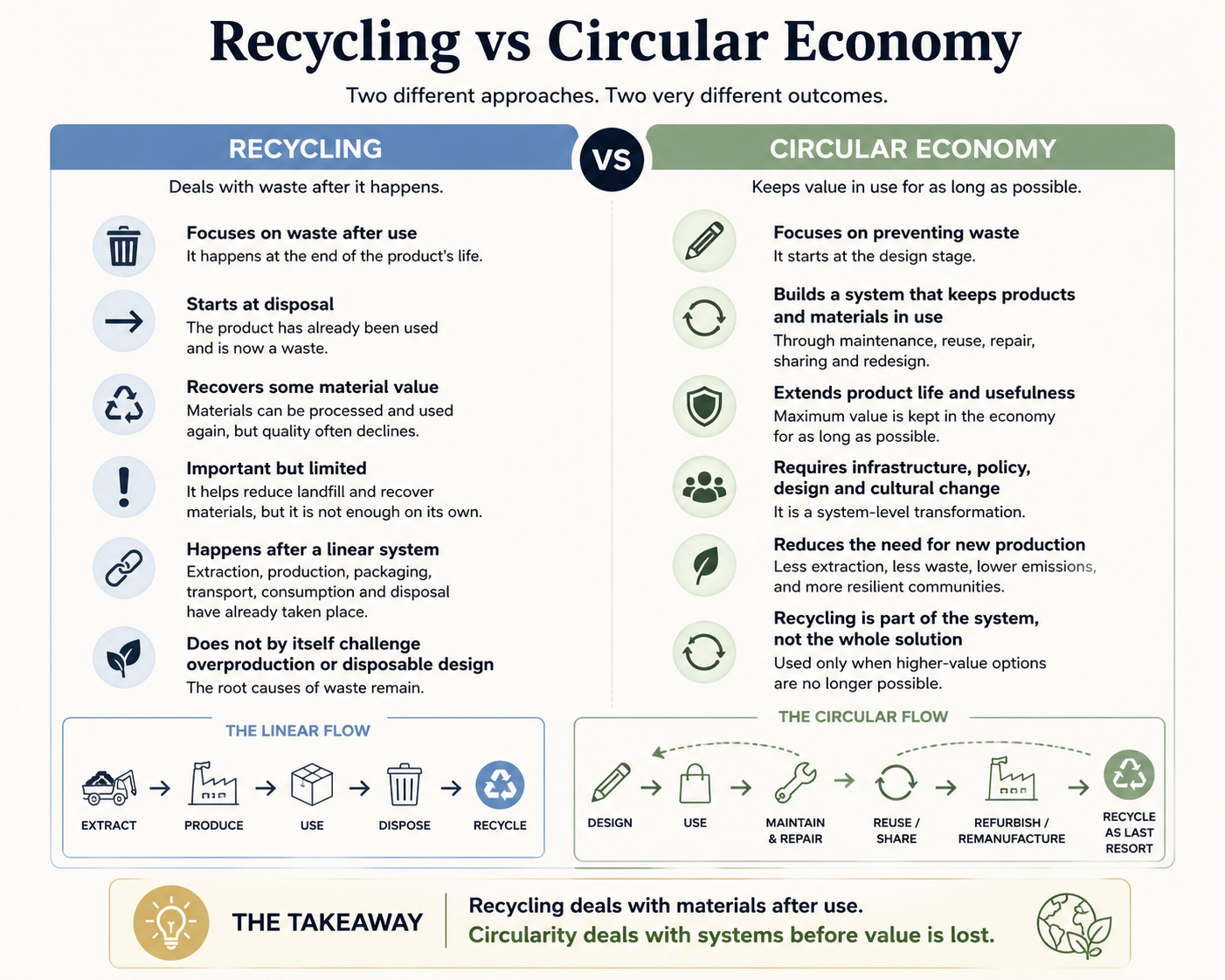
Recycling is mostly concerned with what happens to materials after use. Circularity is concerned with the whole life of the object: why it was made, what it was made from, how it was used, whether it could be maintained, whether it could be shared, whether it could be repaired, whether its parts could be reused, whether its materials could eventually be recovered, and whether the system needed to produce so many of these objects in the first place.
Recycling is downstream. Circularity is systemic.
That distinction matters because once an object is reduced back to raw material, much of its original value has already been lost. A chair is more than wood, screws, fabric, and glue. A phone is more than metals, glass, plastic, and circuits. A jacket is more than fibres. A bicycle is more than steel, rubber, and paint. Each object contains not only material, but design, labour, function, and embodied energy.
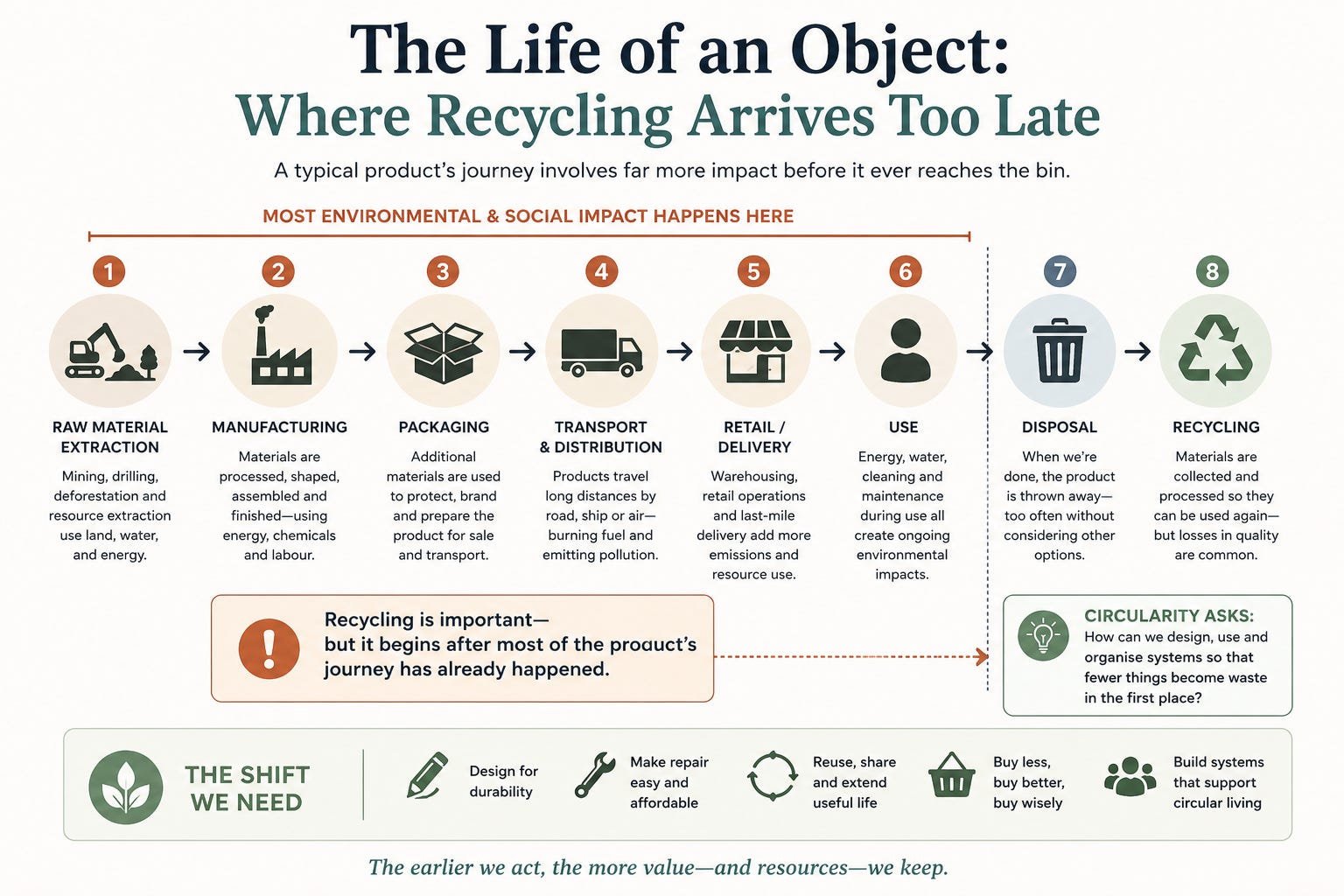
Repair preserves more of that value than recycling does. Reuse preserves more of that value than recycling does. Sharing prevents unnecessary duplication before recycling ever becomes relevant.
That is why the circular economy does not begin by asking, “Can this be recycled?”
It begins by asking, “How can this remain useful?”
III. What the Circular Economy Actually Asks
If recycling became the public symbol of sustainability, the circular economy is often the phrase that arrived later: more ambitious, more technical, and, for many people, less immediately clear.
It sounds good. It sounds responsible. It sounds like something governments, businesses, and cities should be doing. But it can also become one of those phrases that circulates widely without being fully understood. Circular economy. Circular business models. Circular cities. Circular procurement. Circular design. Circular consumption.
The risk is that the phrase becomes smooth before it becomes meaningful.
So let us make it simple.
A circular economy is an economy designed to keep products, materials, and resources in use for as long as possible, while reducing waste, pollution, and pressure on natural systems.
That sounds straightforward, but it represents a major shift. Because the economy most of us live inside is still largely linear. It follows a familiar pattern: take, make, use, throw away. Extract raw materials. Turn them into products. Sell them. Use them. Discard them. Manage the waste. Repeat.
The linear economy is not only a waste-management problem. It is a worldview. It treats nature as an input, products as temporary, disposal as normal, and growth as something measured through the constant movement of new things into the market.
The circular economy asks us to interrupt that rhythm.
It does not begin with the question, “How do we dispose of this better?” It begins much earlier, with questions like: Did this product need to exist in this form? Could it have been designed to last longer? Could it be repaired? Could its parts be replaced? Could it be shared by many people rather than owned by one? Could it be made from safer, renewable, recycled, or recoverable materials? Could the producer remain responsible for it after sale? Could a city, school, library, or community centre help keep it in use?
This is why the circular economy is not simply a more sophisticated word for recycling. It asks us to protect usefulness.
Instead of seeing objects as disposable units moving toward waste, we begin to see them as carriers of material, labour, energy, design, memory, and potential. A product is not finished simply because one owner no longer wants it. A device is not waste because one component has failed. A piece of furniture is not rubbish because it needs repair. A tool is not inefficient because it sits unused in one household; it may simply be waiting for a better access system.
Repair is central because it challenges the assumption that broken means finished. It keeps materials at a higher level of value. It protects skills, knowledge, and local economic activity. A repair culture is not only about fixing things; it is about refusing the idea that replacement is always the easiest, cheapest, or most modern solution.
Reuse is equally important. A desk no longer needed by one office can serve a school. Event materials from one organisation can be used by another. Children’s equipment can circulate between families. Furniture can be redistributed. Clothing can be exchanged, altered, or resold. Public resources can be shared across departments instead of purchased again and again.
Sharing adds another layer. It asks whether everyone needs private ownership of objects used only occasionally. How many households need their own drill? Their own ladder? Their own carpet cleaner? Their own projector? Their own camping gear used once every few years?
In many cases, the need is real, but ownership is inefficient. The circular solution is not deprivation. It is access.
This is where shared public infrastructure becomes essential. A circular economy cannot depend only on virtuous individuals making better choices in the marketplace. It needs systems that make those choices available, affordable, and normal. It needs places where people can borrow tools, repair appliances, exchange materials, learn maintenance skills, and redistribute goods. It needs public institutions that buy for durability and reuse. It needs neighbourhoods designed around access rather than isolated duplication.
Without that infrastructure, circularity risks becoming another lifestyle option for people with enough time, money, space, and knowledge to participate.
With infrastructure, it becomes a public condition.
Design matters too. A circular product is not only a product that can be recycled at the end. It is a product designed for a longer and more flexible life. It may be modular, so parts can be replaced. It may use materials that can be safely recovered. It may be easy to disassemble. It may come with repair information. It may be designed for multiple users, resale, refurbishment, or return.
The circular economy therefore changes what counts as good design.
In a linear economy, a product can be considered successful if it sells. In a circular economy, that is not enough. A product must also endure, adapt, circulate, repair, and return safely into use or material recovery. The question is not only whether people want it now, but what happens to it next.
This is a profound shift because so much of modern consumption has been built around the excitement of the new. New model, new season, new upgrade, new packaging, new device, new trend, new convenience. The circular economy does not reject innovation, but it asks innovation to mature. It asks creativity to move beyond novelty and into stewardship.
Can we design products that age well? Can we design systems that maintain value? Can we design ownership models that do not require every household to duplicate every object? Can we design cities where repair is as visible as retail? Can we design public procurement rules that reward long life instead of low upfront cost? Can we design education systems that teach young people how things work, not only how to buy and discard them?
These are circular questions.
They are also civic questions.
Because the circular economy is not only about materials moving through markets. It is about how societies organise responsibility. In a linear economy, responsibility is fragmented. Producers make. Consumers buy. Waste managers collect. Recyclers process. Governments regulate. Each actor handles one piece of the chain. But no one necessarily holds the whole story.
Circularity asks for a more connected form of responsibility. Producers must think beyond sale. Consumers must think beyond ownership. Cities must think beyond waste collection. Schools must think beyond awareness campaigns. Public institutions must think beyond cheapest purchase. Communities must think beyond private consumption. The system has to become more intelligent because the problem is systemic.
The linear economy taught us that abundance means more things: more products, more options, more upgrades, more deliveries, more private ownership. Circularity asks whether abundance might also mean more access, more durability, more repair, more shared capacity, more local skill, more trust, and less waste disguised as choice.
That is where the idea becomes politically and culturally interesting.
A circular society is not simply a society with better recycling rates. It is a society that has learned to keep value alive. It does not treat maintenance as failure. It does not treat repair as backward. It does not treat sharing as poverty. It does not treat public infrastructure as a last resort for those who cannot afford private ownership.
Instead, it recognises that shared systems can make life richer, not poorer.
IV. From Recycling Bins to Reuse Hubs
Want to read the full essay?
Recycling is only the beginning of the story. The deeper question is what we build before waste exists: repair systems, reuse hubs, smarter public procurement, shared infrastructure, and cities that make sustainable choices easier for everyone.
Subscribe to the REDefine newsletter to access the full post and receive future essays on civic intelligence, sustainability, democracy, and the systems quietly shaping public life.
