

Stability in a World of Postponed Consequences
This is not an essay about collapse.
Collapse is loud. It announces itself. It produces images, headlines, commissions of inquiry. It gives leaders something to respond to.
This is an article about the period before that. The period that feels like success.
Because the most dangerous systems are not the ones visibly breaking down. They are the ones that appear calm, balanced, and responsibly managed, while quietly exporting their costs elsewhere: into the future, into the margins, into people who are not present when decisions are made.
The calm that tells us everything is fine
On a Saturday afternoon in Lisbon, Paris, Berlin, or Milan, fast-fashion stores hum with a familiar rhythm.
Zara. H&M. Mango.
Bright lights. Clean floors. Music designed to keep bodies moving. New collections arriving every two weeks. A jacket cheaper than a meal. Everything is efficient, frictionless, reassuring.
Nothing here suggests danger.
And that absence is not accidental.
Fast fashion is often described as unsustainable, exploitative, environmentally destructive, and all of that is true. But what matters more for our purposes is that it is also extraordinarily stable.
Prices remain low because the real costs do not appear at the point of consumption. They are displaced. They travel.
They travel to garment workers in Bangladesh, Cambodia, and Vietnam earning wages that remain far below living standards. According to the Clean Clothes Campaign, a living wage in Bangladesh would need to be more than three times the legal minimum wage. They travel to rivers in Indonesia that run permanently blue or red from untreated textile dye runoff. They travel to Kantamanto Market in Accra, Ghana, where an estimated 15 million discarded garments arrive every week, overwhelming waste systems and livelihoods.
The calm you experience in the store is real.
It is also conditional.
After the Rana Plaza collapse in 2013, which killed more than 1,100 garment workers, the system briefly lost its composure. The damage surfaced. Brands pledged reform. Audits were introduced. Frameworks were signed. Headlines spoke of a turning point.
Then the cycle resumed.
The industry did not forget. It adapted. It stabilized.
Not because it was repaired, but because the consequences were once again pushed far enough away to stop interrupting daily life in the places that matter most to purchasing power and political stability.
Fast fashion is not an exception.
It is a template.
Stability as a spatial trick
Deferred consequences follow a recognizable logic.
When a system cannot absorb its own costs without disruption, it relocates them:
- across space (from consumer to producer),
- across time (from present to future),
- across power (from decision-makers to those with fewer choices).
This is how calm is manufactured.
Climate governance operates in exactly the same way. High-income countries speak in the language of gradual transitions, innovation pipelines, market mechanisms, and distant targets. The timelines are elegant: 2030, 2040, 2050. The tone is measured. The graphs slope reassuringly.
Meanwhile, the impacts are already being lived elsewhere.
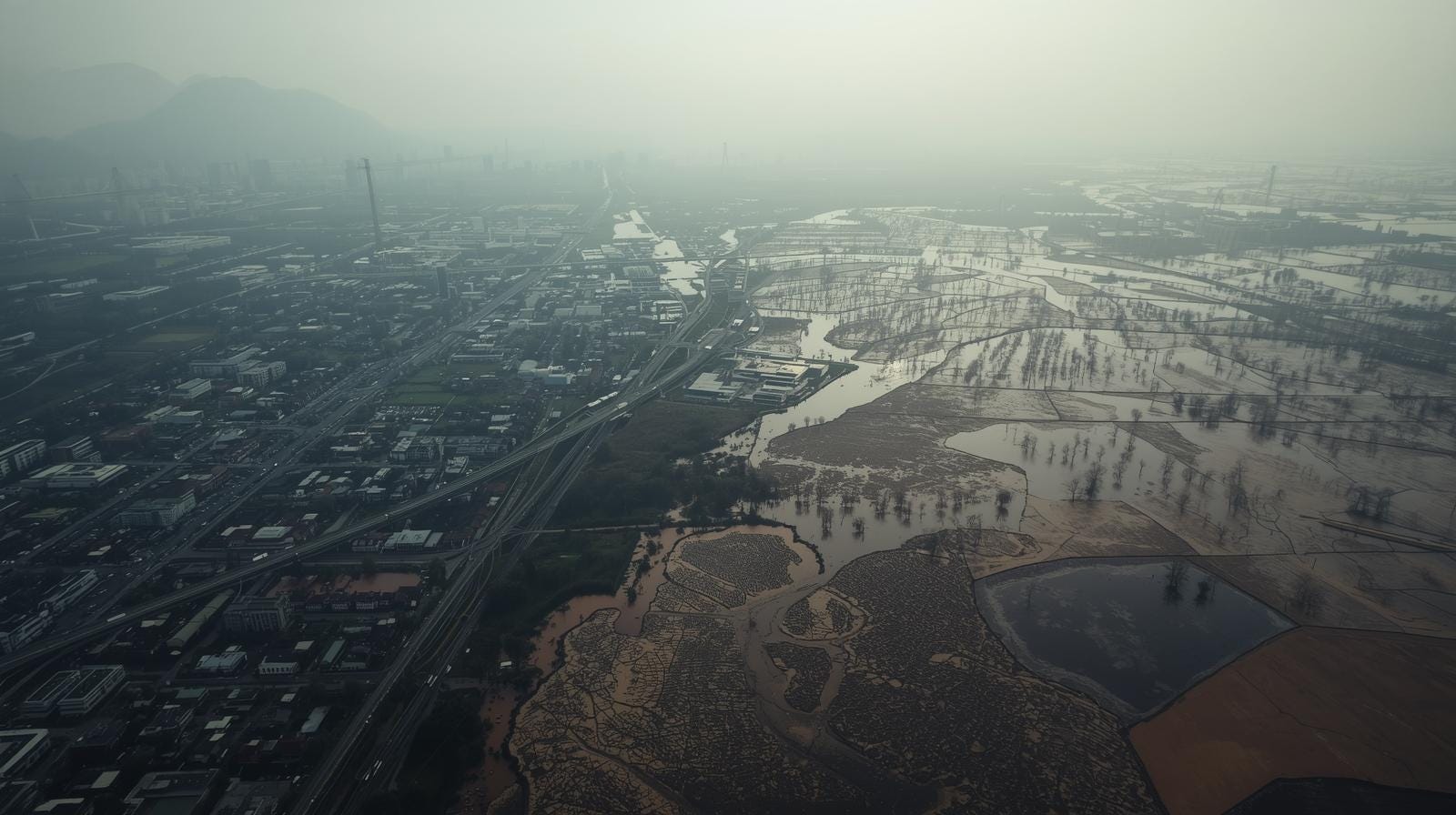
In Pakistan, catastrophic floods in 2022 displaced more than 30 million people. In the Horn of Africa, drought has pushed millions into acute food insecurity. Small island states are planning for partial or total disappearance despite contributing almost nothing to global emissions. According to the Global Carbon Project, the countries least responsible for historical emissions are facing the most immediate consequences.
From one vantage point, the system still looks stable.
From another, the bill has already arrived.
Stability, here, is not balance.
It is geography.
Distance protects the illusion.
Delay as a form of competence
Postponement is often mistaken for indecision. In practice, it has become one of the most refined skills of modern leadership.
Institutions pilot instead of commit. They consult instead of decide. They translate political choices into technical language. They create transition periods that quietly become permanent. They treat urgency as a failure of planning rather than a signal of structural stress.
This is not incompetence.
Political economist Adam Tooze describes contemporary governance as a practice of crisis containment rather than crisis resolution: preventing multiple failures from becoming visible at the same time, rather than addressing their shared roots.
Delay keeps systems governable. It avoids panic. It preserves legitimacy in the short term.
But it also trains leaders to read the wrong signals.
When nothing explodes, postponement feels prudent.
When indicators stay green, intervention feels unnecessary.
When calm persists, responsibility feels abstract.
This is how systems remain operational while losing the capacity to repair themselves.
Borrowing from the future, systematically
Deferred consequences do not only move across space. They move across generations.
Public debt and deferred infrastructure maintenance are obvious examples. But the deeper pattern shows up in education, democracy, and civic life.
Young people are repeatedly asked to be adaptable, resilient, flexible — to prepare for uncertainty as if it were a natural condition rather than a design outcome. They are taught to manage anxiety rather than question its source.
Acrossyouth dialogues, debate formats, classrooms, and immersive civic simulations, the same questions surface again and again:
Why are the hardest decisions always postponed?
Why does every reform come with a transition period that never ends?
Why are we asked to cope with futures we had no hand in shaping?
These are not ideological questions. They are temporal ones.
Sociologist Hartmut Rosa describes this as a loss of resonance: systems continue to function, but they no longer respond meaningfully to those inside them. Time accelerates. Meaning thins. Participation erodes quietly.
The future becomes a buffer: a place where unresolved responsibilities are stored.
The human buffers holding everything together
Every system built on delay relies on buffers.
Workers buffer precarity through flexibility. Families buffer care gaps. Teachers buffer underfunded education systems with unpaid emotional and cognitive labour. Communities buffer environmental damage. Young people buffer incoherent futures with adaptability that is praised as resilience.
But resilience without repair is not strength.
It is endurance under unequal conditions.
This matters because buffers fail silently. When they break, collapse appears sudden. From inside the system, the strain has been visible for years.
What leaders experience as shock is often what others have been carrying all along.
When technology perfects postponement
Digital systems have become the most elegant delay machines of all.
Platforms scale first, regulate later. AI systems are deployed globally while accountability frameworks remain “under discussion.” Harms are acknowledged only after they are widespread enough to be undeniable.
Behind seamless interfaces lies an invisible workforce. Research on AI ghost labour shows millions of workers in the Global South labelling data, moderating content, and training systems under precarious conditions so that digital life in the Global North feels smooth and frictionless.
Stability here is aesthetic.
The cost is absorbed elsewhere.
When time stops cooperating

Deferred consequences rarely arrive gradually.
They arrive as financial crises that appear sudden. As political ruptures described as unexpected. As climate events that overwhelm infrastructure designed for a gentler past. As trust evaporating faster than it was built.
The World Bank has repeatedly documented this pattern: systems optimized for short-term stability experience sharper long-term shocks. What feels abrupt is often simply overdue.
The calm that preceded these moments was real.
It was also borrowed.
Why this matters now
We are writing this because the greatest risk today is not collapse without warning.
It is the systematic misreading of calm as success.
When postponement is mistaken for prudence, we lose the ability to act while action is still possible. By the time consequences become undeniable, choices have narrowed. Costs have concentrated. Repair turns into triage.
The stores are still full.
The reports still balance.
The language remains careful.
Everything still adds up.
But calm is not neutral.
Delay is not always responsible.
Stability is a design choice. And so is what follows from it.
The question is not whether consequences exist.
It is whether we are willing to see them early enough while we still have choices left.
