

How a virtual campus turned theory into empathy, and classrooms into living laboratories of democracy.
I. The Unspoken Question: Can Democracy Be Taught — or Only Practiced?
It didn’t start with headsets. It started with a sentence scribbled in a notebook during a teacher-training workshop in Lisbon:
What if democracy is not a subject, but a setting?
The educators in the room were tired — not of teaching, but of explaining.
They had spent years describing participation to students who rarely felt it. The words “active citizenship,” “deliberation,” “inclusion” rolled off their tongues like currency that had lost its value. One of them finally said, half-joking:
“We’re teaching democracy the way we teach photosynthesis — and expecting photosynthesis to happen.”
That joke became a dare.
What if a learning environment could behave like a miniature society — messy, responsive, unpredictable?
What if students didn’t study democracy from the outside, but performed it from within?
This is how the EU Democracy Campus began — not as a piece of technology, but as a question about method.
Could the act of learning itself become democratic?
Months later, the answer started to materialize inside a network of screens connecting Lisbon, Istanbul, and half a dozen cities between them. Students entered not to listen, but to decide. They debated, voted, negotiated. They disagreed in three languages and still found ways to co-author proposals.
And something subtle shifted: knowledge stopped behaving like content and started behaving like relationship.
“We realised democracy doesn’t live in curriculum plans,” a facilitator said afterward. “It lives in the moment when someone risks saying what they actually think — and someone else chooses to listen.”
That discovery became the heart of the Campus: an experiment in replacing instruction with immersion, and spectatorship with participation.
II. Where Theory Meets Design: The Architecture of Participation
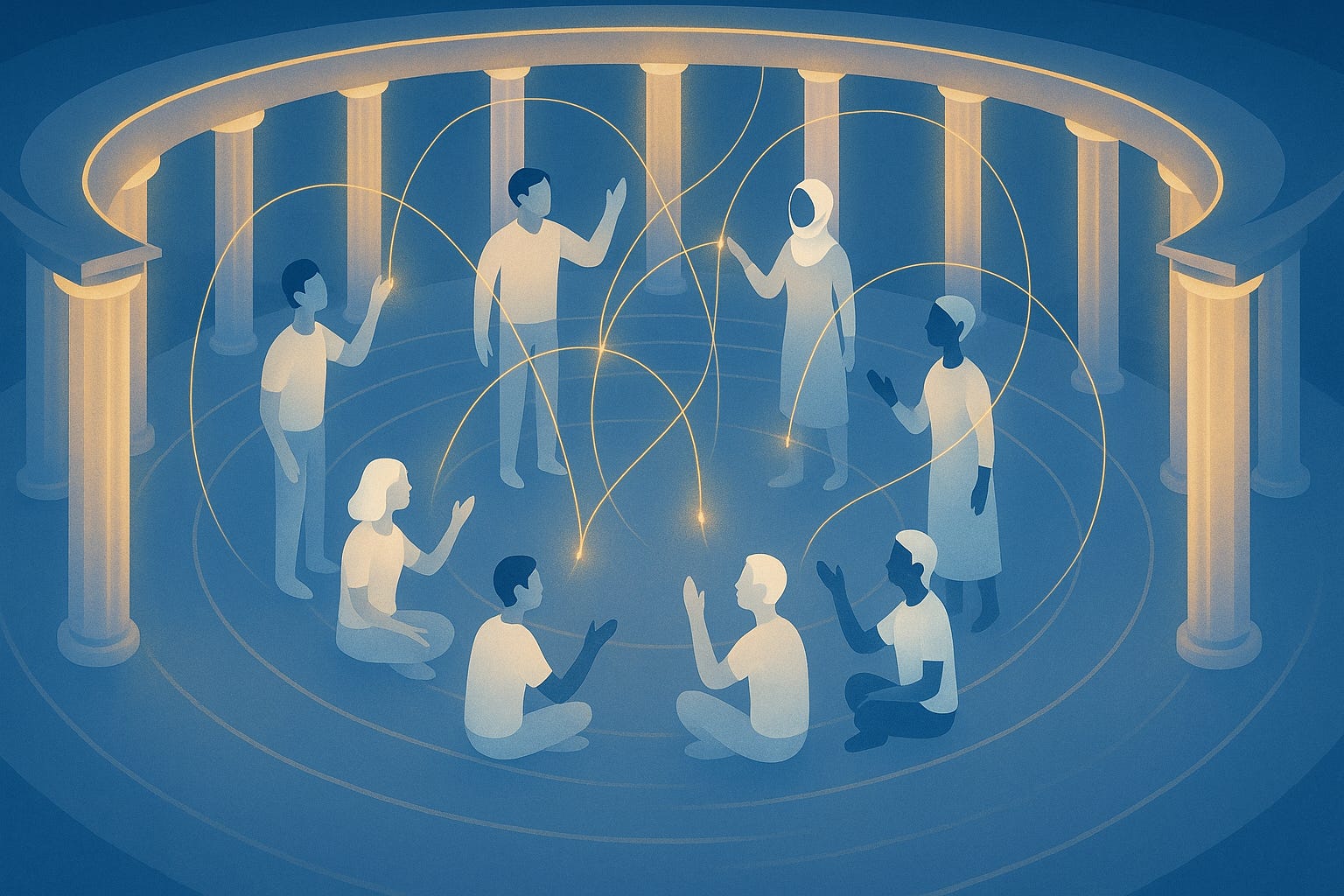
From the beginning, the team refused to separate pedagogy from architecture.
If democracy is an experience, then space must carry meaning.
So we designed the learning journey as a sequence of places — each one teaching without words.
The Galleries opened the arc: a quiet hall filled with reconstructed testimonies, treaties, and fragments of Europe’s turbulent past. From there, they moved into the Agora, a bright courtyard where avatars glowed in real-time conversation. Soon the silence of the Gallery gave way to a controlled chaos of dialogue. Then came the Parliament Hall, where discussion turned procedural. Microphones turned on in sequence, votes appeared on curved screens, and argument met consequence. The space encouraged focus, but not uniformity; it was coded to equalise access, not opinion. Finally, the Activity Rooms invited participants to redesign democracy, laws, institutions and procedures. Each room embodied a phase of democratic practice: remember → reason → decide → imagine.
Movement became pedagogy. The architecture didn’t decorate the learning — it was the learning.
“You move through values, not through slides,” one designer explained.
Inside this choreography, educators saw something they hadn’t witnessed in years of classrooms: agency returning to posture. Students leaned forward, interrupted, gestured, laughed. A young woman from Ankara who had barely spoken on Day 1 led a coalition by Day 4.
Later she said quietly, “It’s the first time my opinion changed something.”
That sentence captured what no assessment rubric could. In that moment, knowledge stopped being information and became participation — and the architecture had made it possible.
III. The Science of Emotional Democracy
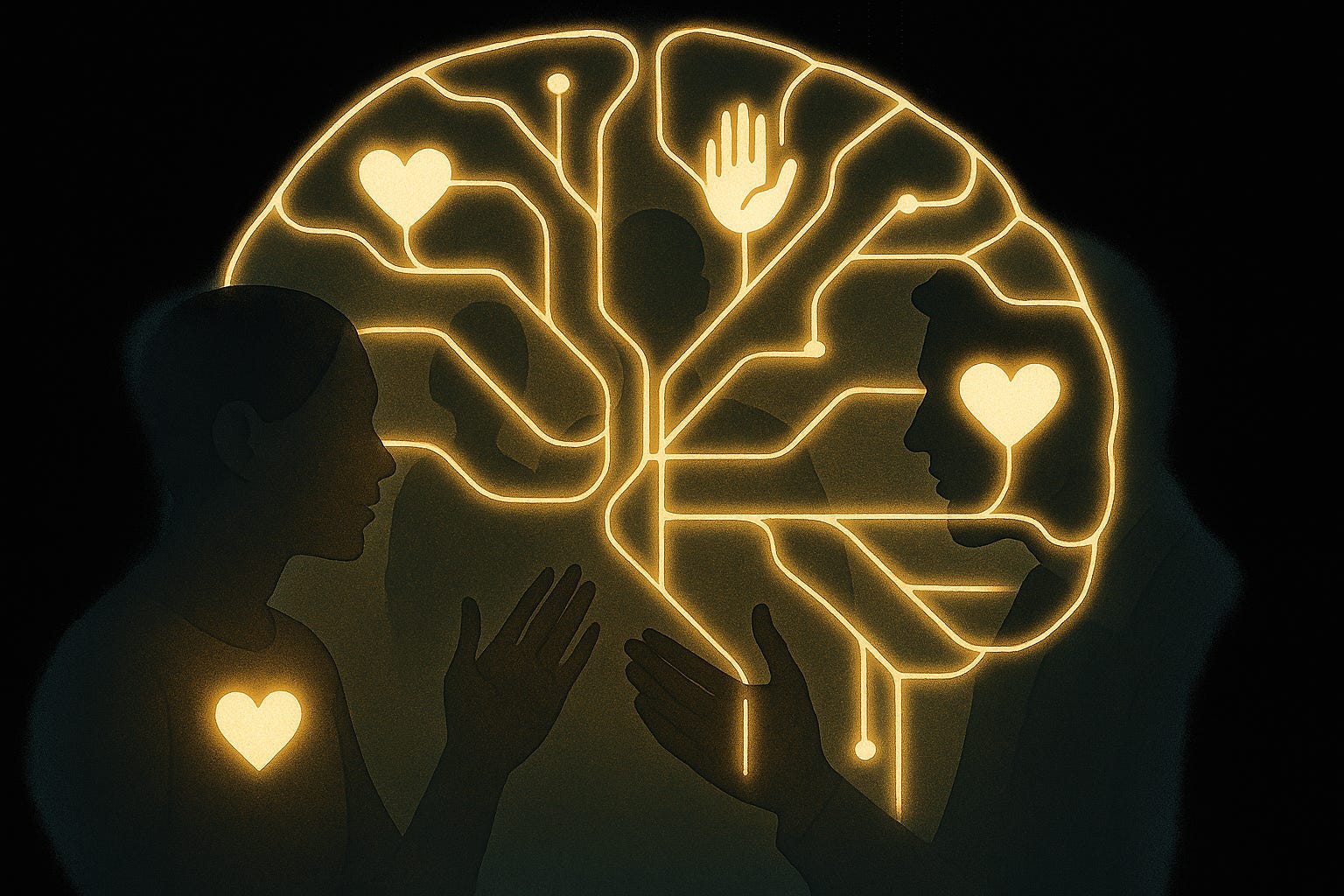
Every democracy begins with a feeling.
Frustration, hope, belonging, outrage — the nervous system fires before the policy forms. Yet most civic education avoids emotion, treating it as interference rather than data.
The Campus did the opposite. It treated emotion as infrastructure.
Before every major simulation, facilitators invited a “check-in.” Instead of cold attendance lists, each participant wrote one word to describe how they arrived: curious, tired, defensive, open.
The words appeared on the virtual wall like constellations of mood. The group could literally see itself feeling.
“Before we built empathy between countries,” one trainer said, “we had to build it between nervous systems.”
After every session came the Reflection Chamber: lights dimmed, microphones muted, and a shared silence encouraged awareness to settle.
At first it felt artificial.
But silence, once awkward, soon became collective respiration.
Students began requesting it.
Neuroscientist Mary Helen Immordino-Yang calls emotion “the rudder of thought.” Without it, reasoning drifts. The Campus design translated that insight into practice: feelings were not background noise but the steering mechanism of cognition.
In daily reflections, facilitators asked questions that bridged the inner and civic:
- When did I feel unseen today?
- What value was I defending?
- Whose silence changed my view?
Through repetition, emotional vocabulary turned into civic literacy. Frustration named became empathy; empathy practiced became agency.
One student wrote in the closing survey:
“I stopped fearing disagreement. I learned to stay.”
That simple line revealed what metrics could only hint at. The emotional architecture of the Campus had begun to train the deepest democratic muscle — the capacity to remain present in tension.
IV. Teaching in 3D: The Human Role in Virtual Space
When the project began, there was an unspoken anxiety: would technology overshadow humanity?
The answer arrived within hours of the first simulation.
Virtual reality could replicate the structure of a parliament, but not its soul. The emotional texture — the trust, humor, hesitation — emerged only when educators stepped into their new role: not as instructors, but as designers of presence.
“In the headset, everyone looks the same,” one facilitator said. “So your attention has to shift from appearance to intention.”
That shift redefined what it meant to teach.
Facilitators became architects of atmosphere.
They set the rhythm of sessions, balancing discussion and silence, work and play. They learned to sense tension through pauses instead of faces, to hear participation through breathing patterns instead of raised hands.
Each day began with a ritual called grounding the signal — a short moment where everyone described how they were arriving, in one sentence. Sometimes, it was practical (“My internet is lagging”), sometimes deeply human (“I am having a bad day, but I’m trying to stay open.”)
These check-ins created the psychological equivalent of eye contact. You couldn’t see each other’s faces, but you could meet through language.
By midweek, the educators noticed something remarkable.
Silence — that old enemy of classrooms — had changed nature. It was no longer a void to be filled, but a shared field of thought. When a student finished speaking, others waited—not because they were told to, but because they wanted to understand before replying.
That, perhaps, was the truest mark of learning in 3D: the birth of reflective tempo.
The paradox was elegant. The more virtual the space, the more real it required people to be. Headsets could create proximity, but not presence. Presence came from empathy, from the facilitator’s calm voice, from the slow confidence that this was not a game, but a rehearsal of civic life.
“Hybrid learning isn’t about gadgets,” one trainer said. “It’s about humanity that scales.”
And in those words, you can hear a quiet revolution in pedagogy: the teacher as system designer, the guide of invisible architectures—of time, tone, and trust.
V. Europe as a Living Laboratory
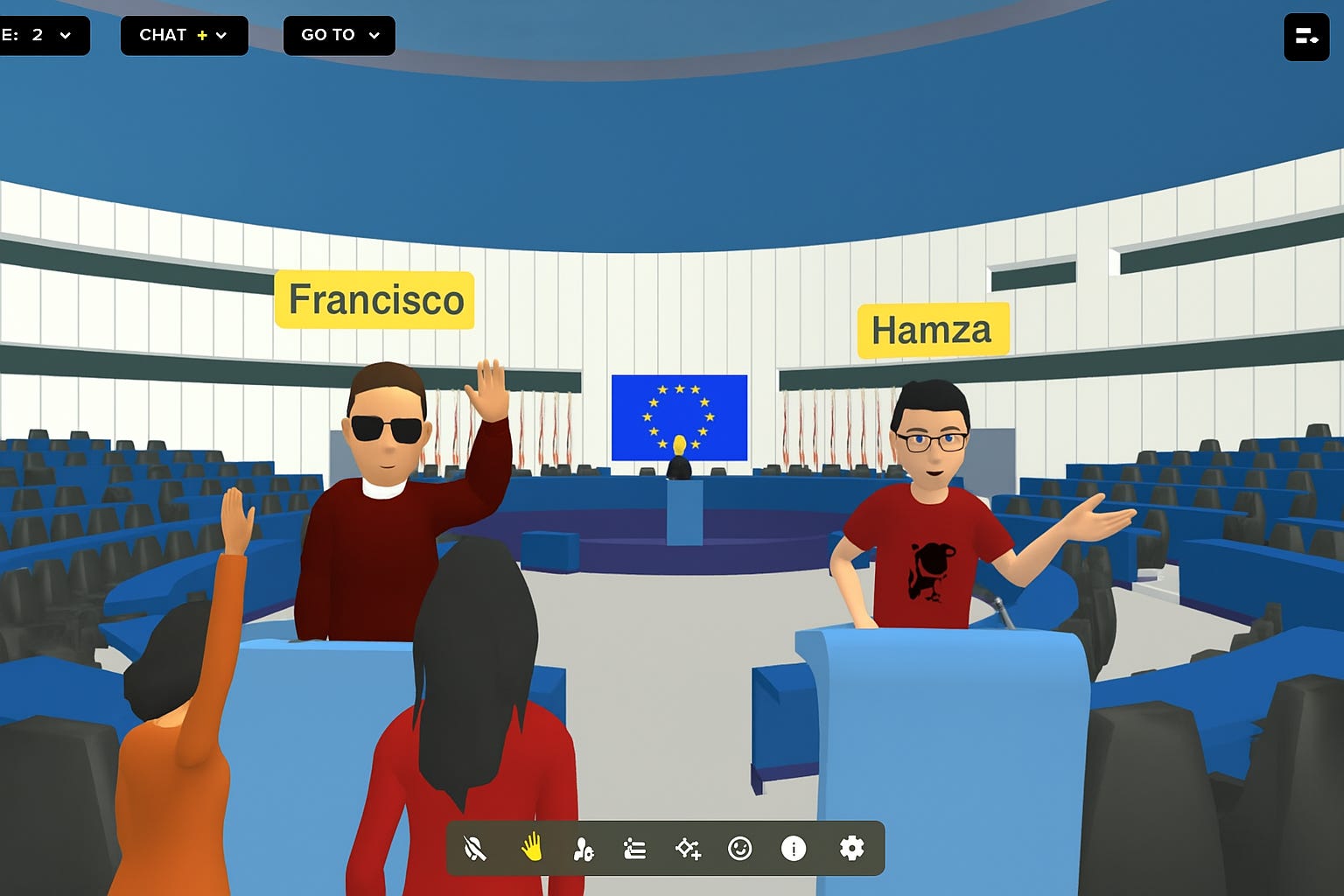
The Campus was never meant to be confined to one country. From the outset, it existed as a European duet — Portugal and Türkiye playing in harmony and dissonance, teaching each other what democracy sounds like in different keys.
In Lisbon, the sessions leaned toward memory and reflection. Students carried stories of dictatorship, revolution, and reconstruction; their discussions turned poetic, sometimes melancholic, circling the ghosts of Europe’s past.
In Istanbul, the mood was kinetic — pragmatic, inventive, urgent. The students debated algorithms, migration, data ethics. They challenged the software itself, questioning who coded the rules and why.
When the two groups met in shared space, something extraordinary unfolded. The reflective met the reformist. Memory met momentum.
“Europe’s memory met Europe’s momentum,” one report later described.
It wasn’t always smooth. The first bi-national debate nearly collapsed under translation lag and cultural nuance. But facilitators treated every glitch as metaphor: communication as democratic friction.
After a pause, we reframed the session around misunderstanding itself. The new debate prompt read:
“Is disagreement a problem to solve or a skill to practice?”
That session became one of the most transformative of the program. Participants began to see that democracy’s strength isn’t harmony — it’s resilience through contradiction.
Quantitative data later confirmed what the human eye had already sensed:
- Knowledge about EU decision-making rose by 22 percentage points.
- Self-reported engagement reached 96 percent, sustained across five consecutive days.
But numbers only tell half the story. The rest lives in the small moments: a Turkish student quoting a Portuguese poet; a shy Lisbon participant volunteering to facilitate the next day’s session; the realization that Europe is not a finished identity but a continuous experiment.
In those moments, the Campus became what the European project has always tried to be: a living laboratory of coexistence.
VI. From Reflection to Action: The Five-Day Arc as a Civic Prototype
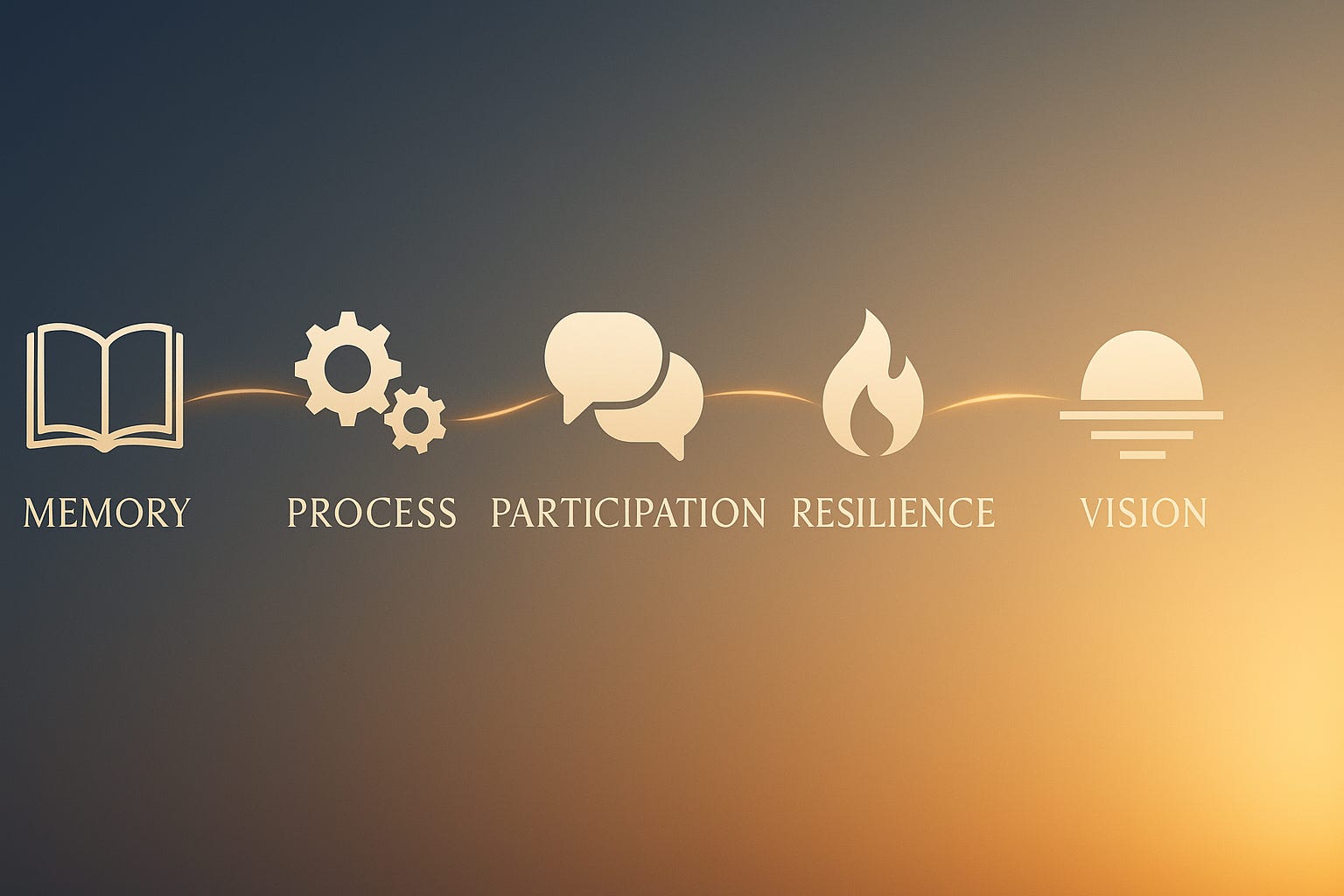
If the Campus had a heartbeat, it was the rhythm of its five-day learning arc — a progression designed to transform curiosity into agency.
Each day wasn’t simply a topic; it was an emotion engineered into motion.
Day 1 — Memory.
Students stepped into the Galleries, walking through traties, memories, projected testimonies from post-war Europe. They were asked a single question: What do we owe the past?
The silence afterward was long. Someone whispered, “To remember differently.” That became the unofficial motto of the day.
Day 2 — Process.
Learners followed the life of a law, tracing it from citizen petition to parliamentary vote. Inside the simulation, they discovered that the hardest part of democracy isn’t decision—it’s procedure. The friction of compromise became palpable; frustration turned into insight.
Day 3 — Participation.
This was the core rehearsal. Divided into teams, students debated an urgent policy—climate action, AI ethics, digital privacy—under real parliamentary rules. The adrenaline of public speaking merged with the humility of listening. Every voice left a visible trace in the shared data wall.
Day 4 — Resilience.
The simulation shifted: a crisis unfolded. Misinformation spread, connections lagged, decisions fractured. The goal wasn’t to “win” but to recover. How do communities rebuild trust after rupture? Students learned the answer by living it.
Day 5 — Vision.
The final day lifted everything upward. Teams entered the Vision Activity rooms to co-design proposals for the Europe they wanted to inherit. Some were pragmatic (a civic mentorship app), others poetic (“A Ministry of Listening”). All were sincere.
“The project began as education,” one youth worker said. “It ended as rehearsal for the future.”
When the week closed, the facilitators asked one last reflection: “What has democracy come to mean for you?”
The answers filled the screen in a slow bloom of text:
“Democracy feels like learning to breathe together.”
“It’s not a system; it’s a habit.”
“It’s what happens between explanations.”
Those words became the final exhibit of the Campus — not the architecture, not the software, but the shared realization that democracy, like learning, survives only when practiced daily.
VII. The Educator’s Mindset: From Instructor to Designer
If the Campus changed the students, it changed the teachers even more.
Most educators arrived with the habits of their profession: explain, mediate, assess. They left with a new identity — curators of democratic space.
One youth worker from Portugal described it best:
“I used to plan sessions like lectures. Now I plan them like environments.”
In that sentence lies the heart of the methodological shift.
The teacher’s task was no longer to deliver knowledge, but to shape conditions under which knowledge could emerge — a blend of emotional design, narrative sequencing, and moral humility.
We describe this as the transition from instruction to orchestration.
Facilitators worked less like conductors and more like jazz musicians — improvising within a shared structure, responsive to the rhythm of the group.
They learned that democracy in learning cannot be simulated if facilitation remains authoritarian.
You cannot teach participation while controlling every moment.
You cannot model empathy while rushing reflection.
“Curiosity over certainty. Patience over performance.”
That became the quiet mantra of the facilitator cohort.
By the end, most admitted the work was more demanding than traditional teaching — emotionally, logistically, ethically. But it was also more alive.
In their closing meeting, the trainers gathered to share what they had learned. Someone said:
“You can’t moderate democracy from a script.”
Another added:
“You have to trust the process enough to let the room surprise you.”
They all nodded — the kind of nod that comes not from agreement, but recognition.
What the Campus had taught them wasn’t a new method. It was a new faith in emergence.
VIII. The Data Behind the Dialogue
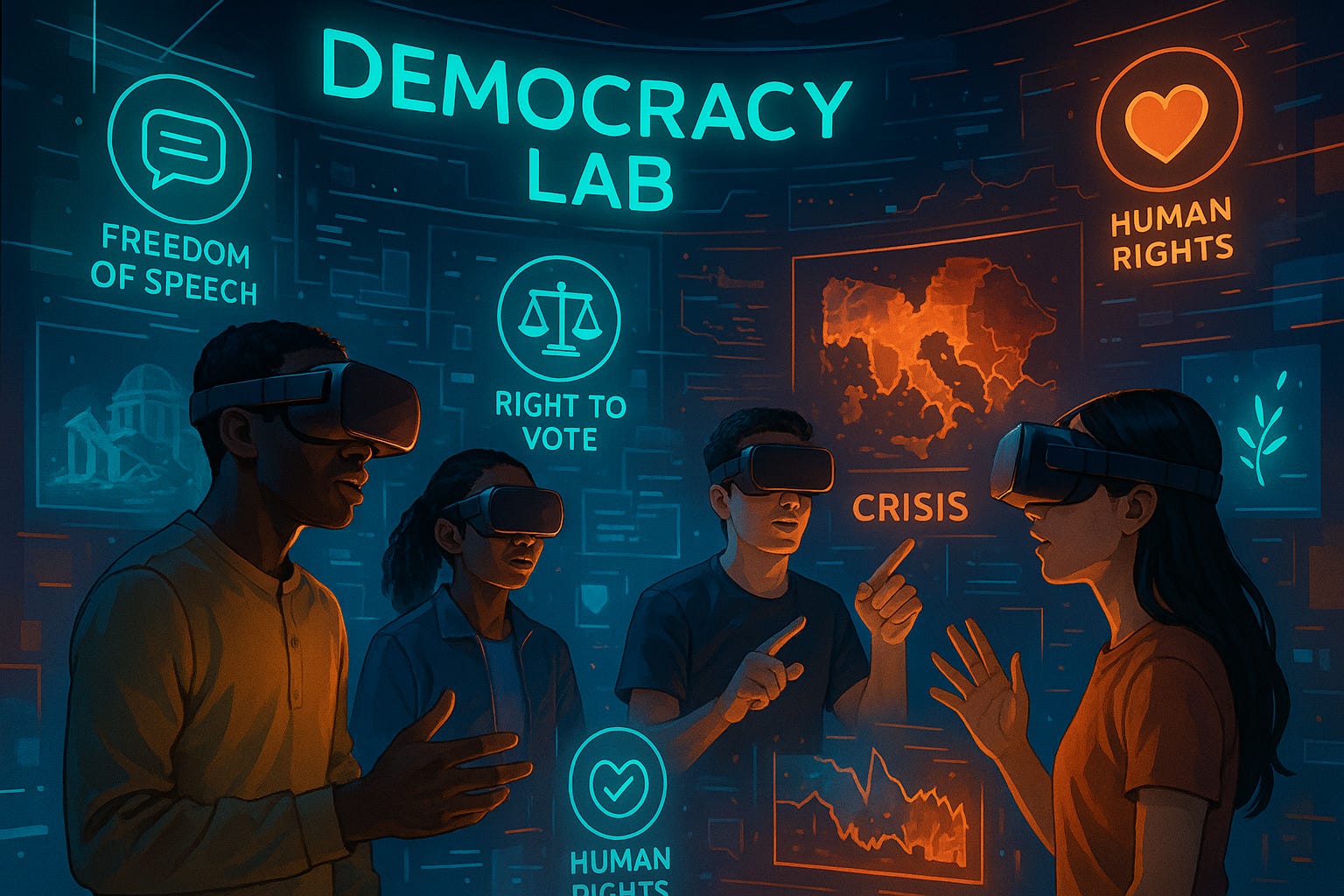
The EU Democracy Campus was, of course, an experiment — and like any experiment, it gathered data. But its real insight lay not in numbers, but in what those numbers meant.
Across both partner countries, evaluation reports revealed measurable shifts:
- 22-point increase in knowledge about EU decision-making.
- 40% rise in self-efficacy — students’ confidence to engage in civic processes.
- Over 90% reported feeling “emotionally engaged” during at least one activity.
- And, weeks later, many participants continued working on civic micro-projects born from their debates.
But behind every percentage was a pattern: reflection had become the metric.
Instead of testing memorization, facilitators assessed change in perspective. Instead of grading performance, they measured growth in voice.
The Campus adopted a simple but profound formula:
Participation = Data.
Every interaction, hesitation, and decision became a trace of learning.
The “analytics of democracy,” as one researcher called it, were qualitative — moments of courage, empathy, initiative.
In post-program interviews, students were asked to define what they had gained. Most didn’t mention facts or frameworks. They said things like:
“I started raising my hand again.”
“I learned to listen to people I disagree with.”
“I realised I don’t need permission to participate.”
These weren’t outcomes in the traditional sense. They were signs of transformation — the invisible data that signal when education crosses into the realm of experience.
As one evaluator concluded, “Metrics can measure learning — but meaning measures democracy.”
IX. Scaling the Experiment: A Blueprint for a Living Europe
After the pilot phase, a question lingered:
Can this model live beyond the headset?
The answer, surprisingly, was yes — because the method was never about technology. It was about designing participation.
Educators began replicating parts of the experience in physical classrooms:
- Using circles instead of rows.
- Replacing quizzes with deliberations.
- Adapting the five-day arc into shorter modules — “Micro-Campus in a Box.”
In Portugal, a rural school used chairs to recreate the Parliament Hall and sticky notes for votes. In Turkiye, a youth centre turned its courtyard into an Agora using chalk lines and speakers. The tools changed; the principle stayed: learning by inhabiting.
This was the quiet revolution — Europe transforming from a continent of classrooms into a network of small living laboratories.
“Every teacher can build a democracy campus,” the team wrote in their final report. “All it takes is space, trust, and curiosity.”
Scaling, then, wasn’t about expansion but about diffusion.
About letting a methodology ripple outward until it becomes culture.
The long-term dream is simple but audacious: to see every school, community hall, or library become a microcosm of civic rehearsal – spaces where disagreement is safe, dialogue is habitual, and participation feels like breathing.
X. What We Learned About Teaching Peace
So, can democracy be taught?
After two years of experiments, debates, crashes, and breakthroughs, the team’s answer is both humble and radical:
No. It can only be experienced with others.
Every time a young person steps into dialogue, every time an educator designs for empathy instead of compliance, a small rehearsal of peace unfolds.
The EU Democracy Campus was never just about technology, or even education. It was about reimagining learning as the social fabric itself — the place where our future citizens rehearse how to care, how to disagree, how to stay.
One of the final reflections came from a student who had joined quietly, rarely speaking until the last day. During the closing circle, she said:
“Before this, I thought peace was something leaders sign. Now I think it’s something we practice every time we decide to listen.”
That line silenced the room. It was the entire project distilled into one sentence:
peace not as absence of conflict, but as presence of attention.
As the facilitators logged off that evening, the virtual hall slowly dimmed. The architecture dissolved, but the learning didn’t. Somewhere between the code and the conversation, democracy had found its classroom again.
📥 Resources
Educators can download the companion resources pack here:
https://associationredefine.substack.com/p/eu-democracy-campus-resource-pack
