

They began with posters and megaphones. Now they’re building the systems that might save us.
1. The Quiet Revolution
For years, youth climate action was measured in decibels — the chants echoing through city squares, the hashtags that trended for a day and vanished by night. Yet beneath the noise, a quieter revolution was taking shape: a generation learning to build instead of merely resist.
It is a shift from protest to profession, from moral urgency to structural design.
And at the center of that shift stands Youth Climate Leaders (YCL) — a movement that began in Brazil and now connects young people across the Lusophone world in a shared mission: to turn climate activism into employability.
When Thamyres da Costa Freitas, YCL’s project manager, spoke at the Youth4Peace Final Conference in Lisbon, she didn’t sound like an activist. She spoke like a systems designer.
Her vocabulary was one of feedback loops, training modules, and career pathways.
Behind her slides was a simple, radical question:
What if fighting for the planet wasn’t an extracurricular activity — but a full-time civic vocation?
YCL was born in 2018, when Brazil faced two intertwined crises — deforestation and youth unemployment. The founders saw that environmental degradation and social precarity were symptoms of the same broken design. Their answer was to build an education model that treated sustainability as both purpose and profession.
By 2021, the model had reached Portugal, creating a bridge between South American energy and European institutional strength. The idea was no longer just to raise awareness — it was to train the workforce of the green transition.
At the conference, Thamyres smiled as she delivered the line that summed it up:
“In the future, there will be no job that is not a climate job.”
2. From Awareness to Architecture
Every generation believes it is running out of time. YCL’s insight is that we are also running out of structure.
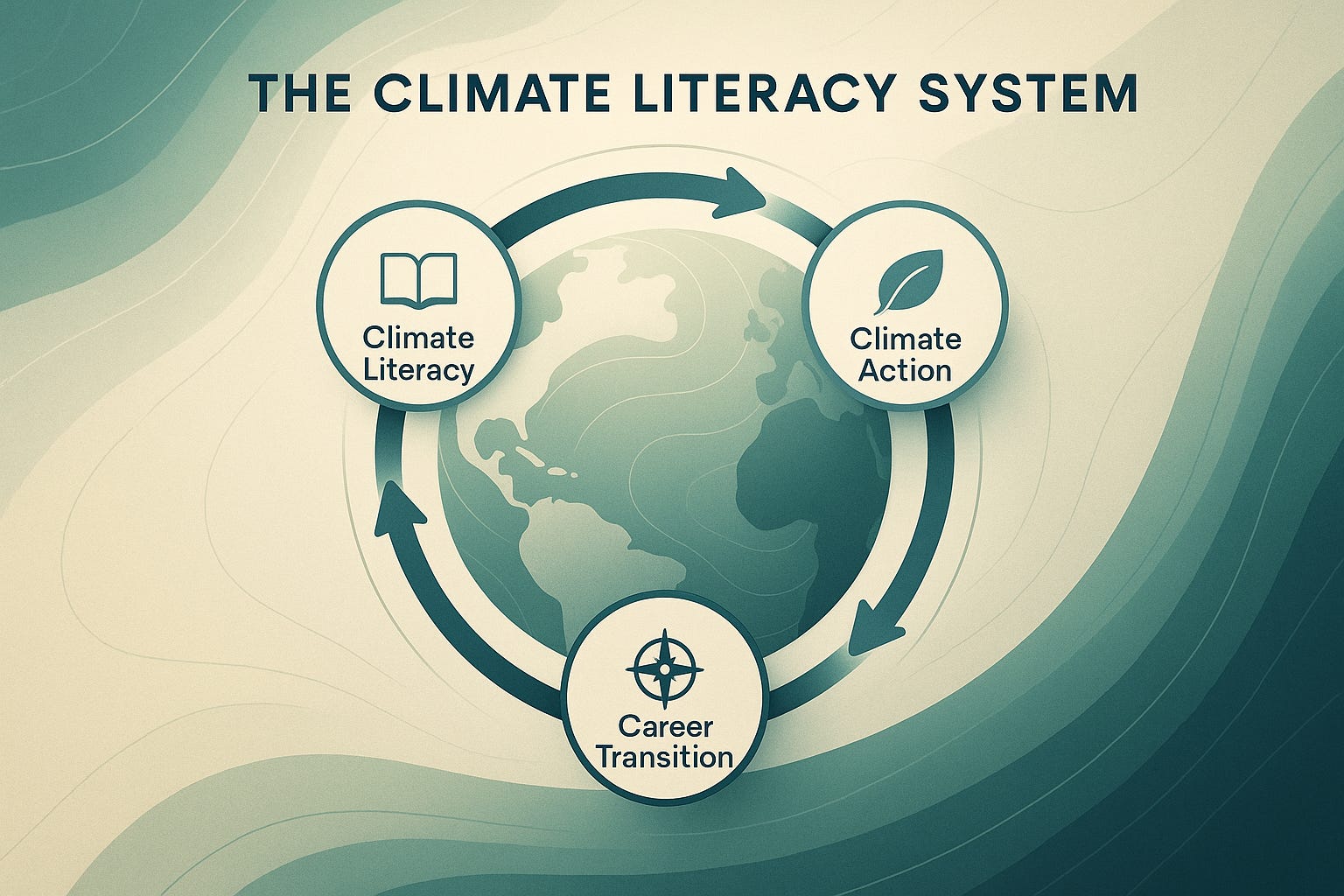
Their fellowship model rests on three interlocking pillars:
- Climate Literacy – understanding the systems behind the crisis.
- Climate Action – translating that knowledge into local projects.
- Career Transition – guiding participants into roles that matter.
It sounds simple. It isn’t.
Most climate programs treat learning as content delivery. YCL treats it as infrastructure — a living network of people, mentors, and communities who keep learning long after the course ends.
Over 140,000 youth have passed through YCL’s courses, workshops, and fellowships. They don’t receive certificates for attendance; they build competence loops — measurable cycles of learning, experimentation, and feedback.
The approach aligns with UNESCO’s Greening Education Partnership, which calls for embedding sustainability at every level of education. But YCL goes further: it fuses education with systems thinking. Fellows don’t memorize facts about carbon; they map interdependencies, design interventions, and evaluate ripple effects.
It’s education engineered as a civic operating system — one that upgrades itself through every participant who uses it.
3. The Laboratory of the Future
Nowhere is this model more visible than in YCL’s coordination of the Local Conference of Youth (LCOY) Portugal, held ahead of COP30.
The process began online with webinars and mentorship circles that reached more than a hundred participants. It culminated in Lisbon, at Casa do Impacto — the same venue that hosted the Youth4Peace Conference.
There, youth from across Portugal and the Lusophone world gathered to draft the Youth Climate Letter to the Government: a concise, data-backed set of recommendations on energy, adaptation, and climate justice.
It wasn’t just a workshop. It was a simulation of governance. Participants learned how negotiations work, how to bridge perspectives, and how to write policy language that gets heard.
When the letter was formally submitted to national authorities, it symbolized something rare — a feedback loop between civic education and state decision-making.
In bureaucratic terms, it was a submission.
In civic terms, it was a rehearsal for the future.
🎥 Watch Thamyres da Costa Freitas’ presentation from the Youth4Peace Final Conference below.
After the applause faded, one thing was clear: these weren’t students of sustainability. They were practitioners of coordination — a skill our world urgently lacks.
4. A Bridge Across the Atlantic
Brazil and Portugal share language, but not the same civic DNA.
In Brazil, engagement is passionate but precarious. Civil society drives innovation where the state cannot.
In Portugal, institutions are strong but participation is modest; bureaucracy often replaces initiative.
YCL’s transatlantic identity makes it a translator between systems. It imports Brazil’s participatory spirit into European frameworks — and exports Europe’s policy discipline back to Latin America.
This dialogue reveals something larger than a program. It’s a design prototype for the green transition itself: a fusion of heart and structure, of grassroots energy and institutional access.
That is why the organization refuses to frame the climate transition merely as a set of new jobs.
The real project is cultural — teaching societies to think ecologically, to see every profession as part of a planetary feedback system.
An engineer learns life-cycle thinking; a teacher brings climate literacy into civic education; a communicator learns to measure impact instead of reach.
As one mentor summarized:
“We don’t train environmentalists. We train system mediators.”
The phrase captures the quiet revolution YCL is leading — creating professionals fluent in translation: between science and society, policy and practice, North and South.
And this translation runs both ways. Paulo Freire’s philosophy of education as liberation, born in Brazil, resurfaces in YCL’s participatory pedagogy, now informing European institutions. It’s a rare inversion: the South teaching the North how to innovate with empathy.
5. Learning to Govern Complexity
Every generation inherits both problems and possibilities. The challenge of this century is that our problems are complex, while our institutions remain linear.
Climate change is not a scientific failure; it’s a coordination failure.
We have the data, the funding, the innovation — but not the connective tissue that turns them into collective action.
YCL’s model offers a glimpse of that connective tissue. It re-wires how we learn and collaborate, showing that education can be a mechanism of governance.
Its fellows aren’t waiting for permission; they’re building the civic software of a post-carbon society.
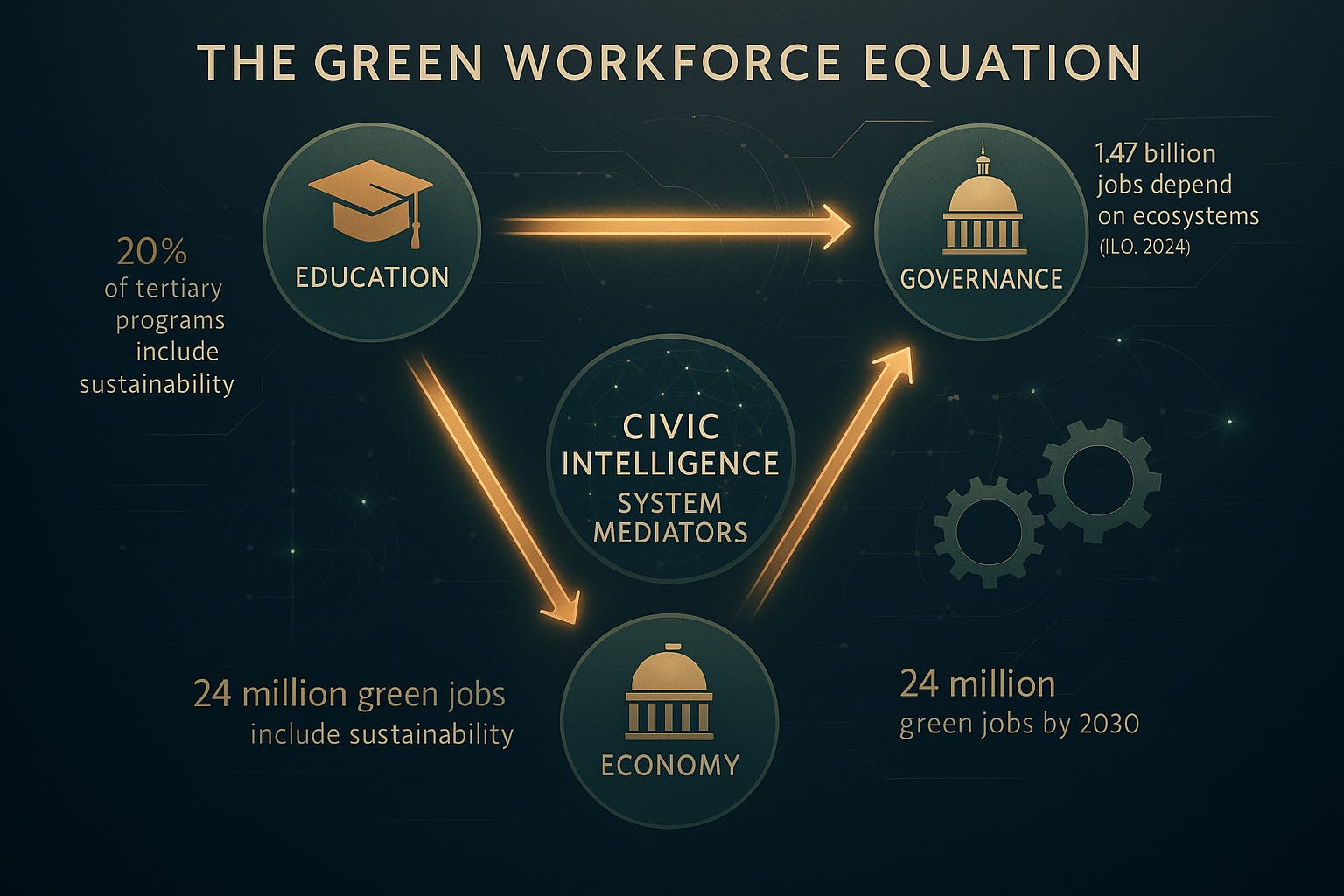
According to the International Labour Organization, 24 million green jobs could be created by 2030 if education systems adapt. But adaptation is not only about curricula — it’s about mindset.
YCL teaches a growth mindset for the planet: mistakes as learning data, uncertainty as design material.
The organization’s impact can’t be captured only in metrics, though the numbers are strong — 90 mentors, 15 specialized programs, alumni in 12 countries. Its real achievement is psychological: turning anxiety into agency.
It is what REDefine calls civic intelligence — the collective capacity to perceive complexity and act within it.
At a time when algorithms reward outrage and fragmentation, this is the opposite energy: constructive, systemic, interdependent.
YCL’s approach reminds us that hope is not a feeling; it’s a framework.
Conclusion — The Generation That Designs Back
When future historians describe the climate generation, they might not start with Greta’s speech or the marches of 2019.
They might start here — with the quiet architecture of networks like YCL that turned emotion into infrastructure.
From Brazil to Portugal, from classrooms to COP conferences, these young leaders are teaching the world how to govern complexity with empathy.
They are not only reacting to systems; they are redesigning them.
If the twenty-first century demands one universal skill, it is the ability to connect what already exists — to transform data into dialogue, and dialogue into design.
That is what Youth Climate Leaders are practicing: not activism alone, but adaptive architecture for a living planet.
🌱 Read the Full Longform
The complete edition of The Climate Generation includes on Substack includes:
- The in-depth framework “Building Your Own Climate Literacy System”
- 10 actionable design principles for educators and institutions
- Data and insights from UNESCO, ILO, OECD, and UNDP
- Expanded analysis of YCL’s Brazil–Portugal model
If you want to go deeper or support our work, you can subscribe here: https://substack.com/@associationredefine
