

We’ve been fed the same mantra for decades: toughen up, push through, be strong.
But here’s the problem: toughness is brittle. It’s the glass that looks solid—until it shatters.
True resilience isn’t about clenching your jaw and pretending nothing hurts.
It’s about bending and recovering, like bamboo swaying through a storm.
And in an age of relentless upheaval—pandemics, climate shocks, political fractures—understanding that difference might be the single most important survival skill we can learn.
The Myth of Grit-Only Resilience
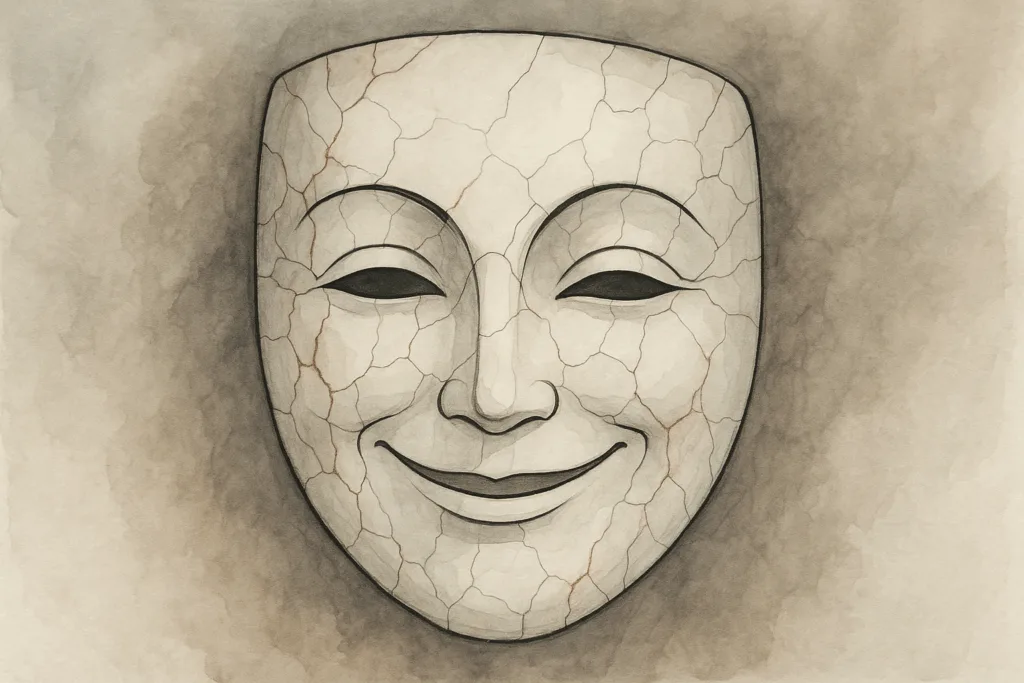
In our culture, grit is often glorified. Hustle harder. Smile through the exhaustion. Don’t let them see you crack.
But grit without flexibility is just stubbornness. It’s armor that keeps the world out—and often locks us inside.
Research backs this up. Studies from Yale’s Center for Emotional Intelligence show that suppressing emotions actually lowers our capacity to adapt. In other words: toughness can backfire.
And here’s a nuance rarely discussed: grit works best for short bursts, not long-haul uncertainty. Angela Duckworth’s famous studies on grit show it predicts achievement in structured environments (like school or military training). But when the ground is shifting—like in a pandemic, climate crisis, or job disruption—grit alone is not enough. We need adaptability, community, and reflection to sustain us.
What Resilience Really Looks Like
The American Psychological Association defines resilience not as “soldiering on” but as adapting well in the face of adversity.
That’s a critical shift. Adaptation isn’t about grinding harder—it’s about moving differently.
Resilience is:
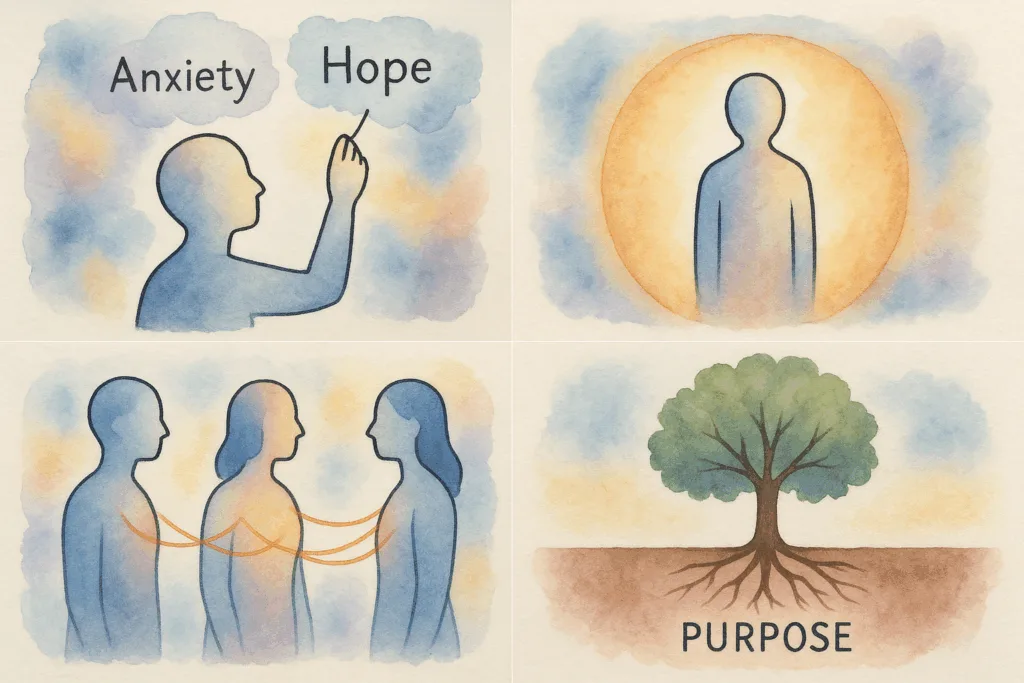
- Emotional literacy — naming feelings instead of denying them. UCLA research shows that labeling emotions calms the amygdala and reduces stress responses.
- Boundaries — protecting our energy before burnout strikes. The American Institute of Stress identifies chronic overcommitment as one of the strongest drivers of workplace burnout.
- Connection — because people who recover fastest are those with strong support systems. Harvard’s 80-year-long study of adult development is crystal clear: close relationships are the single strongest predictor of resilience and well-being.
- Purpose — having “why-power.” Viktor Frankl, a Holocaust survivor, argued that meaning—not toughness—helped people endure. Modern studies on post-traumatic growth echo this: purpose transforms pain into possibility.
And resilience isn’t just personal—it’s collective. After the 2011 earthquake and tsunami in Japan, communities that rebuilt together—organizing shared kitchens, childcare, recovery circles—recovered faster and reported lower trauma levels. Research in The Lancet confirmed it: social cohesion directly fuels recovery.
This isn’t only about healing trauma. Research from MIT shows that teams with higher “psychological safety” outperform others by 20%. Resilience, it turns out, isn’t only a survival skill—it’s also a productivity advantage.
Beyond the Individual: Systemic Resilience
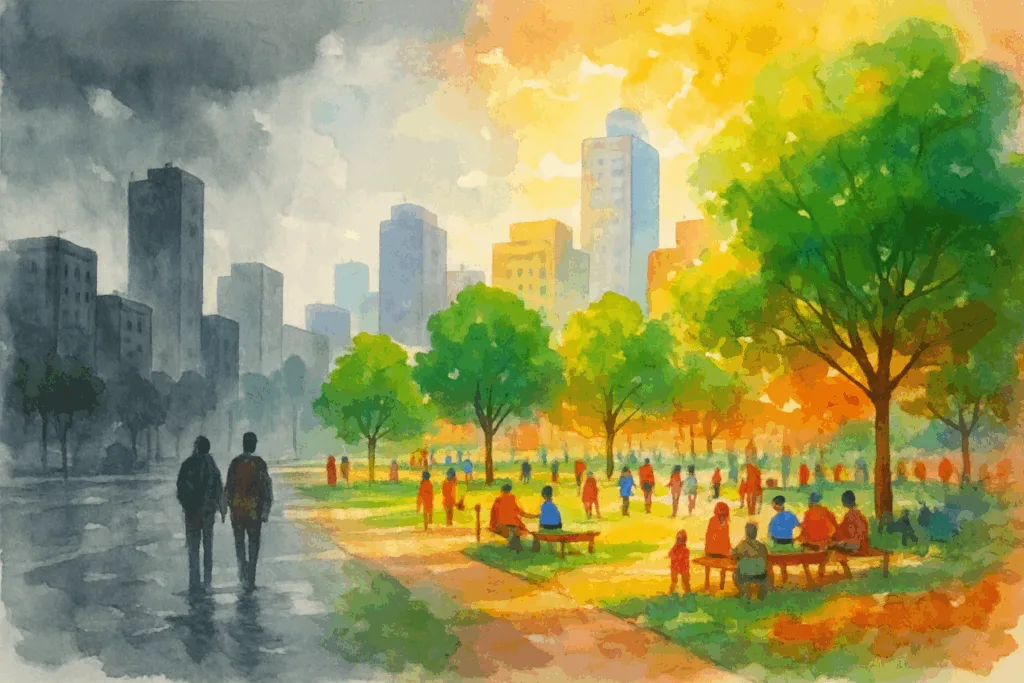
Most advice on resilience focuses on the individual: meditate, journal, breathe. But resilience without systems that support it is like planting bamboo in concrete. It won’t grow.
Gallup’s workplace studies reveal that supportive organizational cultures cut burnout by nearly half. Likewise, community-level resilience—like mutual aid networks during COVID-19—shows that design matters as much as mindset. Resilient people burn out in broken systems. Resilient systems lift up everyone.
Even cities matter. Studies in urban planning suggest that communities with green, social spaces bounce back faster after crises. Parks and shared public spaces are more than amenities—they are resilience infrastructure.
And neuroscience adds another angle: resilience is trainable. Because of brain plasticity, practices like mindfulness, naming emotions, and building supportive routines literally strengthen adaptability like a muscle.
Fault Lines Where We Break
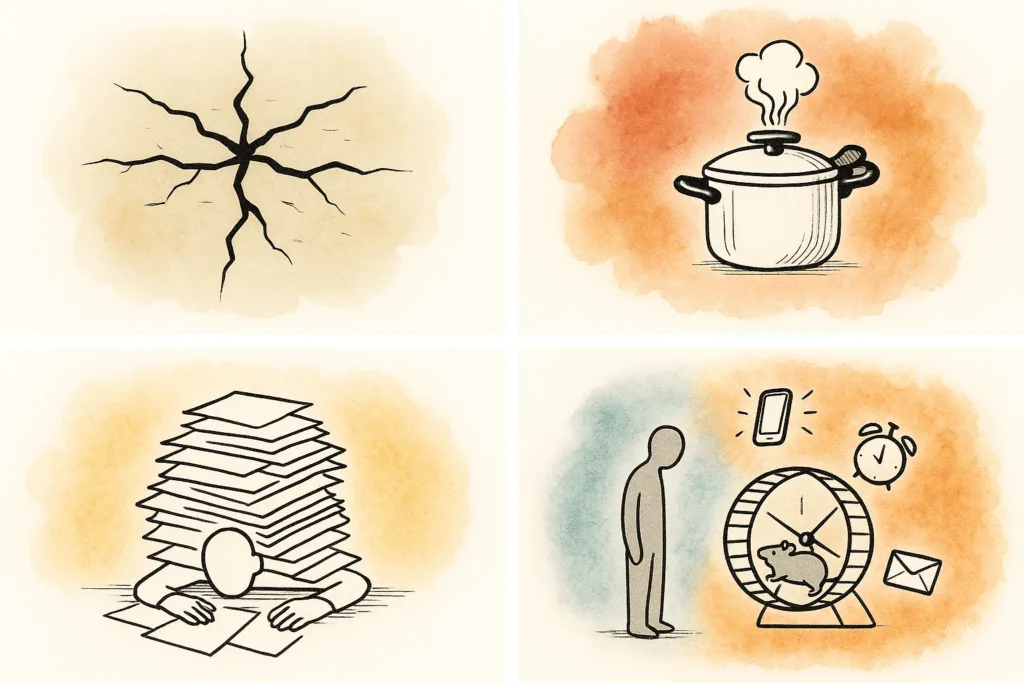
Most breakdowns don’t come from “weakness.” They come from:
- Denying stress until collapse — emotional repression that leads to depression and physiological strain.
- Saying yes to everything — chronic overcommitment that drives burnout.
- Isolating when we most need connection — loneliness that raises the risk of premature death by 26% (National Academies of Sciences).
- Confusing busyness with progress — Stanford research shows multitasking and chronic busyness actually impair memory and reduce productivity.
Here’s another hidden fault line: digital overload. Studies show that constant notifications and digital multitasking trigger stress pathways in the brain similar to being in survival mode. Resilience today isn’t just about emotional skills—it’s also about managing technology.
Spotting these fault lines is the first step in designing resilience that lasts.
Tools for Real-World Resilience
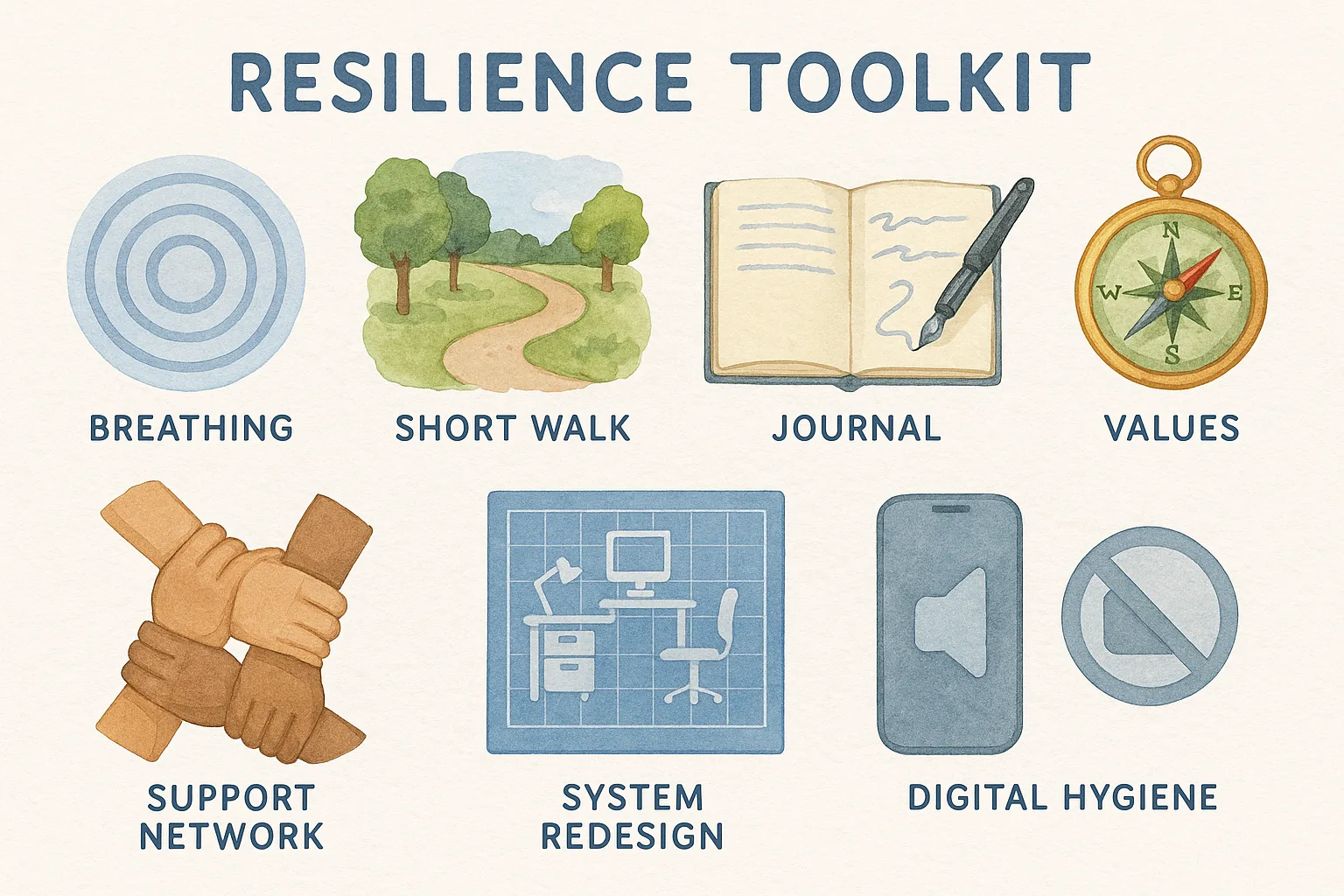
So how do we do it? Not with slogans, but with practices that combine inner skills and outer design.
- Name and frame. Acknowledge what you feel—“I’m anxious,” “I’m grieving”—instead of masking it. Clarity is strength.
- Micro-recovery rituals. Ten deep breaths. A five-minute walk. Journaling. Stanford’s Center for Compassion research shows even small acts of mindfulness improve stress regulation.
- Anchor in values. In crisis, values are your compass. People who align with core values experience higher resilience and meaning after trauma.
- Build your net. Find your “three people.” Friends, mentors, colleagues. You don’t bounce back alone—you bounce back together.
- Redesign the system. If the environment constantly drives burnout, resilience isn’t surviving it—it’s reshaping it. Gallup’s workplace research confirms: supportive cultures dramatically lower burnout and turnover.
- Digital hygiene. Set tech boundaries—batch notifications, unplug regularly, and protect deep focus. Research shows that mental recovery requires true downtime, not scrolling.
Toughness breaks. Resilience bends and rebuilds.
It’s not about gritting your teeth through crisis. It’s about knowing yourself, protecting your energy, and leaning on others.
And it’s not just a personal skill—it’s a civic one. In a world of shifting ground, resilience isn’t armor. It’s architecture.
So here’s the real invitation: Don’t just “tough it out.” Rebuild. Together. And remember: resilience isn’t just what you carry inside—it’s what we design outside.
Watch the companion video here →
Share it with someone who’s still stuck in “tough it out” mode. Because the ground is shifting—and resilience is how we build what lasts.
